
The Army Field Hygiene Manual, in plain English for families
TC 4-02.3 is the Army's short guide to staying healthy in the field, away from normal plumbing. It's written for soldiers and their leaders, but almost all of it applies to a family after a storm, during a long power or water outage, or on a camping trip: keeping clean, washing hands, making water safe, keeping bugs and pests away, and getting enough sleep.
Quick facts
| Full title | TC 4-02.3, Field Hygiene and Sanitation |
| Published by | Headquarters, Department of the Army |
| Date | 6 May 2015 · listed as Active, the current edition |
| Length | 48 PDF pages: 3 chapters plus a water appendix |
| Written for | Commanders, leaders, soldiers, DoD civilians and contractors p. iii |
| Free to share? | Yes. Approved for public release; distribution is unlimited cover |
| Replaced | FM 21-10 (June 2000), per the Army Publishing Directorate |
| Best for families | Personal hygiene and health (ch. 2) and water treatment (app. A) |
| Safe to skip | Leader duties (ch. 3), military supply items and workplace chemicals |
The official Army manual
The full TC 4-02.3, straight from the Army Publishing Directorate. Free, no email needed.
⬇ Download the official PDF (0.4 MB)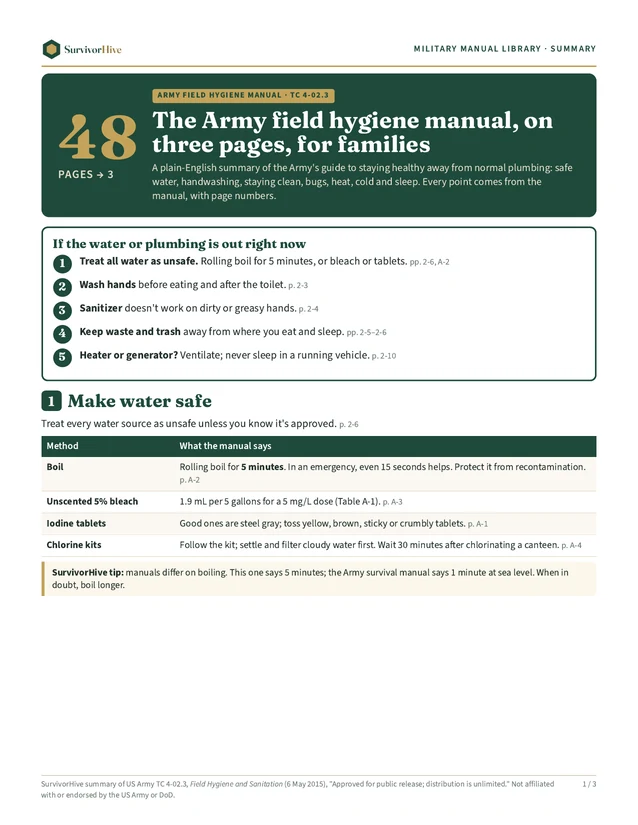
SurvivorHive Summary
3 printable pages: water treatment, handwashing, staying clean, bugs, and heat, cold and sleep basics, with page numbers.
Get it free by email →If the water or plumbing is out right now
- Treat all water as unsafe. Bring it to a rolling boil for 5 minutes, or use unscented bleach or purification tablets. p. 2-6 p. A-2
- Wash hands before eating and after the toilet. Use soap and clean water when you can. p. 2-3
- Sanitizer only on clean-looking hands. It doesn't work on dirt or grease. p. 2-4
- Keep waste and trash away from where you live and eat. They draw flies and rodents. p. 2-5 p. 2-6
- Running a heater or generator? Ventilate, and never sleep in a running vehicle. p. 2-10
What this manual is, and what it isn't
TC 4-02.3 gives soldiers and leaders hygiene and sanitation guidance for the field and deployments. p. iii It's short, practical and mostly about habits. It doesn't replace medical advice, and some sections cover military gear or workplace chemicals you can skip.
| The Army calls it | What it means for you |
|---|---|
| DNBI | Disease and non-battle injuries: getting sick or hurt from something other than combat. p. 1-1 |
| Potable water | Water that's safe to drink |
| Nonpotable water | Water you shouldn't drink until it's treated. p. 2-4 |
| Arthropods | Insects, ticks, mites and other bugs that bite and spread disease. p. 2-6 |
Ch. 1Why hygiene matters so muchMost military casualties weren't from battle.
Historically, around 80% of reported US military casualties came from disease and non-battle injuries, not combat. p. 1-1 The drop in those numbers since is credited to things like awareness, training, and access to safe food, clean water, laundry, showers and toilets. p. 1-1
For a soldier
Soldiers are each responsible for their own health in the field: washing, dressing for the weather, using repellent, treating water and getting rid of waste properly. p. 2-1For your family
After a storm, during a long outage or on a camping trip, your family is in the same spot: no normal plumbing, and small habits make the difference between staying well and getting sick.Ch. 2Pack a hygiene kitWhat the Army suggests keeping on hand.
The manual lists items like these: p. 2-1 p. 2-2
Ch. 2Keeping clean without a showerSkin, washing and laundry.
- Your skin is your body's first line of defense. Keeping it clean helps prevent infection from small cuts and cracks. p. 2-2
- Shower daily if you can, or at least once a week. With no shower, wash daily with a washcloth, soap and water, focusing on sweaty areas: armpits, feet, groin, between the thighs and under the breasts. p. 2-2
- A full canteen of water is enough for one person's washcloth bath. p. 2-3
- Skip perfume and scented soaps outdoors; they attract insects. Unscented lotion keeps skin from cracking. p. 2-3
- Change into clean clothes at least once a week, and don't share clothing, bedding or towels with someone who has lice. p. 2-3
- Keep feet dry: change into clean, dry socks and use foot powder. p. 2-2
Ch. 2Handwashing: the most effective habitWhen to wash, and what to use.
Washing or sanitizing your hands often is one of the most effective things you can do to protect yourself and others. It can prevent colds, and serious diseases like infectious diarrhea. p. 2-3
At a minimum, wash
- Before and after eating
- Before handling or preparing food
- After using the toilet
- After touching anything that could carry germs
- Often through the day
Ch. 2TeethSimple habits that keep you from a dental emergency.
- Floss at least once a day, and brush at least twice a day, especially before sleeping. p. 2-4
- After brushing with fluoride toothpaste, wait 30 minutes before rinsing, eating or drinking. p. 2-4
- No toothpaste? Brush anyway. No toothbrush? Rinse after eating, wrap a cloth around a finger and wipe your teeth and gums. p. 2-4
- Just a few days without brushing can inflame the gums. p. 2-4
App. ASafe water and foodTreating water when you're not sure it's safe.
Treat every water source as unsafe unless you know it's been approved, and treat it whenever there's any doubt. p. 2-6
| Method | What the manual says |
|---|---|
| Boiling | Bring it to a rolling boil for 5 minutes. In an emergency, even 15 seconds helps. Protect boiled water from getting contaminated again. p. A-2 |
| Unscented 5% household bleach | The manual's table lists 1.9 mL of bleach per 5 gallons for a 5 mg/L chlorine dose. p. A-3 |
| Iodine tablets | Good tablets are steel gray. Throw out any that are yellow or brown, stick together or crumble. p. A-1 |
| Chlorine tablets or kits | Follow the kit's instructions; cloudy water is settled and filtered first. p. A-4 p. A-5 |
- Wait at least 30 minutes after treating a canteen with chlorine before using the water. p. A-4
- Chlorine taste? Pour the treated water back and forth between two clean containers. p. A-2
- Avoid food, drinks, ice and dairy from sources you can't trust. p. 2-6
Ch. 2Bugs, rodents and trashRepellent, nets and keeping pests away.
Of the 80 diseases the military considers important, more than two-thirds are spread by insects, ticks, rodents and other animals. p. 2-6
The Army's three-part bug defense
- Permethrin-treated clothing and bed nets
- Insect repellent on exposed skin
- Wearing clothing properly (sleeves down, pants tucked)