
The Army Survival Manual, in plain English for families
The US Army's survival manual is free, it's public, and it's full of good information. It's also written for a soldier who's been cut off from their unit, so it's packed with military terms. This page turns it into something a family can actually use: the handful of ideas that matter most, the numbers worth remembering, what you can safely skip, and a link to download the full manual straight from the Army.
Quick facts
| Full title | ATP 3-50.21, Survival |
| Published by | Headquarters, Department of the Army |
| Date | 18 Sep 2018 · the current edition, listed as "Active" by the Army Publishing Directorate |
| Length | 228 pages: 8 chapters and a knots appendix |
| Written for | Soldiers, Army civilians, and contractors who are cut off and waiting to be rescued |
| Free to share? | Yes. Distribution A: "approved for public release; distribution is unlimited" |
| What it replaced | It came out of the revision of FM 3-05.70 (2002), which replaced the well-known FM 21-76 |
| Best for families | Water (ch. 3), fire (ch. 5), shelter and clothing (ch. 6), mindset and first aid (ch. 1–2) |
| Safe to skip | Evasion and military reporting, hunting and trapping, and improvised weapons (most of ch. 4 and ch. 8) |
The official Army manual
The full ATP 3-50.21, straight from the Army Publishing Directorate. Free, no email needed.
⬇ Download the official PDF (23 MB)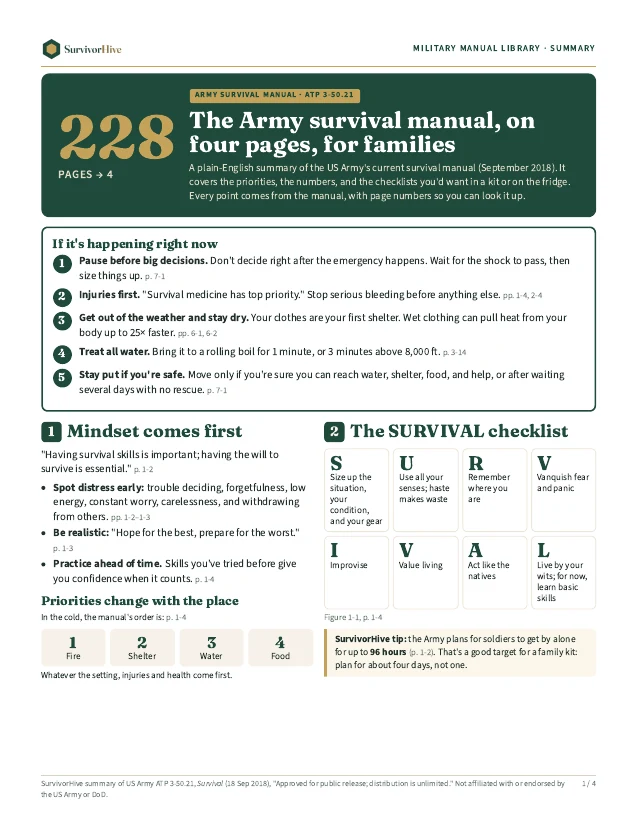
SurvivorHive Summary
The whole manual on 4 printable pages: priorities, numbers, and checklists for your fridge or go-bag.
Get it free by email →If this is happening right now
- Stop and breathe before you decide anything big. The manual says to avoid making any decision right after the emergency happens. Wait until the shock wears off, then size things up. p. 7-1
- Deal with injuries first. "In all isolation situations, survival medicine has top priority." Stop serious bleeding before anything else. pp. 1-4, 2-4
- Get out of the weather. Your clothes are your first shelter, so keep them dry. Wet clothing can pull heat from your body up to 25 times faster than dry clothing. pp. 6-1 to 6-2
- Treat all water before you drink it. Bring it to a rolling boil for 1 minute, or for 3 minutes above 8,000 feet. p. 3-14
- Stay put if you're safe. Move only when you're sure you can reach water, shelter, food, and help, or after you've waited several days and you're convinced help isn't coming. p. 7-1
What this manual is, and what it isn't
ATP 3-50.21 is the Army's handbook for "survival in an isolated situation." That means one soldier, or a small group, separated from their unit and waiting to be recovered. Preface, p. vii Some of it is about reporting in, avoiding the enemy, and meeting up with a rescue team. You can skip those parts.
The rest is good, practical knowledge that fits a car stuck in a snowstorm, a hike that runs late, or a power outage that lasts longer than anyone expected. The manual groups survival into four skill areas, and they map neatly onto a family's needs. Table 1-1, p. 1-1
| The Army calls it | What it means for your family |
|---|---|
| Survival medicine | First aid, staying clean, and avoiding illness |
| Protection | Clothing, shelter, and fire |
| Sustenance | Water first, then food |
| Navigation | Knowing where you are and which way is which |
A useful number for parents: the manual notes that Army forces are typically equipped to survive for up to 96 hours on their own. p. 1-2 That's a good benchmark for a family emergency kit: plan for about four days, not one. Our 72-hour emergency prep guide is a simple place to start.
Ch. 1Mindset comes first"Having the will to survive is essential." Includes the SURVIVAL checklist.
The manual opens with your head, not your gear: "Having survival skills is important; having the will to survive is essential." para 1-9, p. 1-2
What the manual says
- Stress is normal, and it can help. Stress can sharpen you, but too much of it turns into distress. The manual lists the warning signs: trouble making decisions, forgetfulness, low energy, constant worry, carelessness, mistakes, withdrawing from others, and angry outbursts. pp. 1-2 to 1-3
- Be realistic. See the situation as it is, not as you wish it were. "Hope for the best, prepare for the worst." p. 1-3
- Stay positive. Look for the good, and look at everyday objects as possible tools. p. 1-4
- Train before you need it. People who practice their skills ahead of time have the confidence to use them under pressure. p. 1-4
The SURVIVAL checklist
Figure 1-1, p. 1-4
Priorities change with the place. The manual calls this the "survival pattern." In the cold, for example, the order is fire, then shelter, then water, then food, all while keeping everyone healthy. Whatever the setting, injuries and illness come first. para 1-19, p. 1-4
For a soldier
A soldier is trained to keep panic in check.For your family
A family has kids watching how the adults react.Ch. 2First aid and staying healthyThe MARCH order, stopping bleeding, shock, heat and cold injuries.
This is one of the longest chapters (36 pages). Most of it assumes a trained soldier carrying an Army first-aid kit. Here's what carries over to a family.
What the manual says
The order to treat injuries. The manual follows the Army's MARCH order: Massive bleeding, Airway, Respiration (breathing), Circulation, and Head injury/Hypothermia. pp. 2-1 to 2-2 If there's no major bleeding, start with the airway. p. 2-3
Bleeding that can kill. Treat it as life-threatening if blood is spurting or flowing steadily, pooling on the ground, or soaking through clothes or bandages, or if the person is going into shock. p. 2-4 The manual notes that a badly injured thigh can bleed out "within as little as three minutes." p. 2-4
- Direct pressure over the wound is "the most effective way to control external bleeding." p. 2-6
- For a life-threatening arm or leg wound, use a tourniquet. The manual places it 2 to 3 inches above the wound. An improvised tourniquet should be a band at least 1½ inches wide twisted tight with a stick. Belts and zip ties are a last resort. pp. 2-4 to 2-5
- Never put a tourniquet around the neck. p. 2-8
Shock
Expect it in anyone who's hurt. Watch for anxiety, confusion, nausea, pale, cool, and clammy skin, fast breathing, and heavy thirst. The manual's treatment p. 2-12:
- If they're awake, lay them flat with their feet raised 6 to 8 inches.
- If they're unconscious, roll them onto their side so they don't choke.
- If you're not sure, lay them flat, and don't move them once they're settled.
- Keep them warm and dry: get wet clothes off and insulate them from the ground.
- Give no food or drink by mouth to someone who's unconscious or has a belly wound.
Heat illness pp. 2-31 to 2-32
- Heat cramps: rest in the shade and slowly sip about a quart of water an hour, with ¼ teaspoon of salt in it.
- Heat exhaustion: the skin is cool and clammy, often with headache, heavy sweating, weakness, and dizziness. Rest in the shade, pour cool water on them and fan them, raise their legs, and have them sip water.
- Heatstroke is the most dangerous. The person stops sweating and has hot, dry skin, and may be confused or pass out. Cool them fast in cool water, or soak their clothes, focusing on the groin, armpits, back, and neck.
Cold injury pp. 2-32 to 2-33
- Hypothermia can happen fast, and "the temperatures do not have to be very cold." Signs include uncontrollable shivering and clumsy movements. Get them into dry clothes, give warm drinks slowly, and warm them evenly. For a severe case, that can include skin-to-skin contact inside a sleeping bag.
- Frostbite: don't thaw it near an open flame. Rewarm it in water between 99 and 109°F.
- Frostnip (chilblains): warm it with body heat, and don't rub or massage it.
Dehydration pp. 2-33 to 2-34: "Once personnel are thirsty, they are already dehydrated." Look for dark, strong-smelling urine, peeing less often, sunken eyes, and tiredness. In the heat, avoid hard work during the hottest hours. When water runs short, ration your sweat, not your water. Don't drink alcohol, urine, blood, or seawater.
Staying clean prevents a lot of illness pp. 2-2 to 2-3: Wash your hands after the bathroom, after caring for someone who's sick, and before touching food or drinking water. Put latrines 200 feet from water and away from where you sleep. Keep feet clean and dry, and aim for 7 to 8 hours of sleep.
What the manual puts in a medical kit p. 2-3: water purification tablets, antibiotic ointment, iodine, super glue, an emergency blanket, dental floss, duct tape, a heavy needle, dressings and bandages, a tourniquet, and a supply of your prescription medications. That's a solid starting list for a family kit.
For a soldier
The manual covers airway tubes and other gear and techniques from military medical kits.For your family
A family doesn't need those. Focus on the order of care, stopping bleeding, shock, heat and cold, and staying clean.Ch. 3Water: your most urgent needThe most useful chapter for families.
"Water is one of the isolated person's most urgent needs."