
The Army Cold-Weather Manual, in plain English for families
The Army rewrote its cold-weather handbook in September 2025, replacing a version from 1986. It's written for soldiers operating in snow and extreme cold, so a lot of it is about skis, sleds and tactics. Underneath that is solid advice any family can use in a winter storm or a cold-weather outage: how to dress, eat and drink, and how to spot and treat hypothermia, frostbite and carbon monoxide poisoning.
Quick facts
| Full title | TC 21-3, Soldier's Handbook for Individual Operations and Survival in Cold-Weather Areas |
| Published by | Headquarters, Department of the Army |
| Date | 30 September 2025 · listed as Active, the current edition |
| Length | 136 PDF pages: 7 chapters plus appendixes |
| Written for | Soldiers operating in cold-weather areas |
| Free to share? | Yes. Approved for public release; distribution is unlimited |
| Replaced | TC 21-3 dated 17 March 1986 cover |
| Best for families | Dressing (ch. 2), food, water and cold injuries (ch. 4), survival and shelters (ch. 7) |
| Safe to skip | The combat and patrol chapters (ch. 3 and 5), skis and sleds |
The official Army manual
The full TC 21-3, straight from the Army Publishing Directorate. Free, no email needed.
⬇ Download the official PDF (8 MB)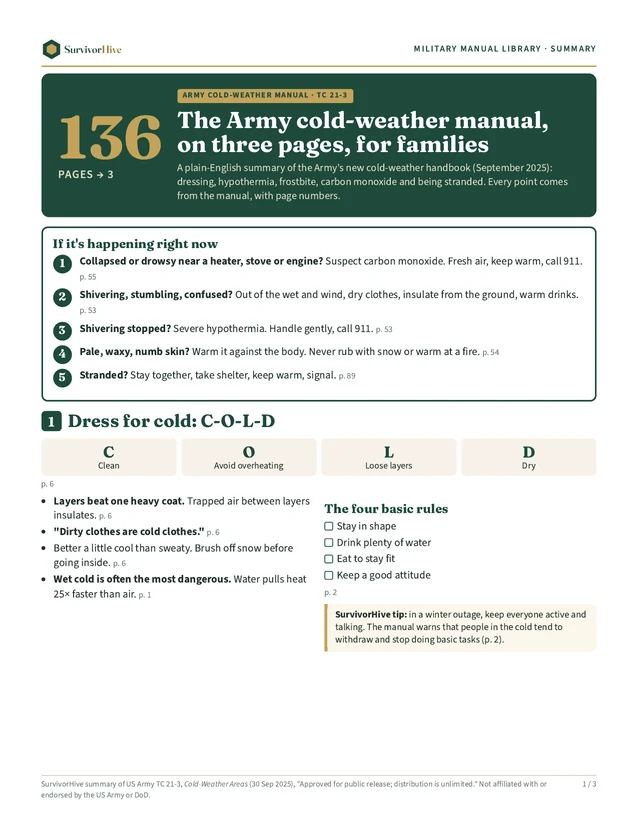
SurvivorHive Summary
3 printable pages: dressing in layers, hypothermia, frostbite, carbon monoxide and being stranded, with page numbers.
Get it free by email →If it's happening right now
- Someone found drowsy or collapsed near a heater, stove or running engine? Suspect carbon monoxide. Get them into fresh air, keep them warm, and call 911. p. 55
- Shivering, stumbling or confused? Get them out of the wet and wind, into dry clothes, insulated from the ground, with warm drinks. p. 53
- Shivering has stopped? That's severe hypothermia. Handle them gently and call 911. p. 53
- Pale, waxy, numb skin? Warm it against the body. Never rub it with snow or warm it at a fire. p. 54
- Stranded or lost? Stay together, get out of the weather, stay warm and signal. Smoke by day, flame at night. p. 89
What this manual is, and what it isn't
TC 21-3 is the Army's handbook for the individual soldier living and working in cold-weather areas, from wet cold near freezing to hazardous cold below –40°F. p. 1 It covers clothing, physical care, movement over snow, and survival. It isn't a cold-weather course, and parts of it are about military gear and tactics you can skip.
| The Army calls it | What it means for you |
|---|---|
| Wet cold | Around freezing, with rain, slush and wet snow. Often the most dangerous. p. 1 |
| Dry cold | Colder but drier. Easier to stay warm if you're dressed for it. p. 6 |
| Group hibernation | Everyone hiding in sleeping bags and letting chores slide. Keep people active. p. 2 |
| Hypothermia wrap | Layers of tarp, pad and sleeping bags around a cold person. p. 53 |
Ch. 1How the Army thinks about coldWet cold vs. dry cold, and the four basic rules.
The manual counts weather as cold from 39°F on down, and splits it into five zones, from wet cold (39°F to 20°F) to hazardous cold (–40°F and below). p. 1
Wet cold is often more dangerous than deeper, drier cold. Slush, mud and wet clothes pull heat away, and water conducts heat 25 times faster than air. Wet cold can quickly lead to hypothermia, frostbite and trench foot. p. 1
The four basic rules
- Stay in shape
- Drink plenty of water
- Eat to stay fit
- Keep a good attitude
In hard cold, people tend to withdraw, crawl into sleeping bags and stop doing basic tasks. The manual's remedy is physical activity and staying alert. p. 2
For a soldier
Soldiers train for weeks in the cold; the manual says most can cope after 3 to 4 weeks. p. 3For your family
You'll likely face cold in short bursts: a winter storm, a power outage, a stuck car. The same rules apply: stay dry, eat, drink, and keep everyone moving and talking.Ch. 2Dressing for cold: C-O-L-DLayers, and the four rules that keep clothing warm.
Several layers beat one heavy garment, even one as thick as all the layers together, because trapped air between them insulates. p. 6 The Army's system is built on three ideas: insulate, layer and ventilate. p. 5
Ch. 4Food and water in the coldWhy you need more of both, and how to make water from snow.
- Eating keeps you warm. Most of what we eat and drink goes to keeping the body warm. Hard work in the cold takes about 4,600 calories a day. p. 47
- You lose water fast in the cold, through sweat and breathing. Hot, sweet drinks replace fluid and add calories. p. 47
- Thirst is a late sign. By the time you feel thirsty, you're already dehydrated. Dark yellow urine in the snow is a warning. p. 55
- Don't eat snow. It lowers your body temperature and can cause stomach aches. Melt it first. p. 55
Making water from snow and ice
Ice gives more water, faster, than snow. Melt a little snow in the pot first, then keep adding more. Bring it to a rolling boil to purify it. Collect snow upwind and uphill of any toilet or trash area. p. 48
Ch. 4Hypothermia and the "umbles"The warning signs, and how to warm someone up.
This manual says hypothermia begins when the core body temperature falls below 95°F: mild is 90–95°F, moderate 80–89°F and severe below 80°F. All levels are emergencies that need a medical facility. p. 52
Watch for the "umbles"
Fumbles, stumbles, tumbles, grumbles and mumbles: first fine motor skills go, then walking, then judgment and personality. Shivering is the first thing you'll notice, and when shivering stops, it's severe. p. 52 p. 53
What to do
- Move them from cold and wet to warm and dry
- Swap damp clothing for dry clothing
- Add a windproof or waterproof layer, or get them into shelter
- Add insulation under and around them
- Give food and warm drinks
A hypothermia wrap (the manual's "burrito"): a tarp or poncho on the ground, an insulating pad, a sleeping bag, then the person inside a second bag with a hot water bottle on the chest (not against bare skin), a third bag on top, and the tarp folded around them. p. 53
Ch. 4FrostbiteHow to prevent it, tell how deep it is, and rewarm it.
Frostbite happens when skin freezes, below 32°F. Feet, hands, ears and the face are hit first. It may tingle, sting or ache, and the skin turns red, then pale gray or waxy white. p. 53 p. 54
Prevent it
- No tight boots or socks
- Use the buddy system to check each other's faces, especially in wind
- Carry extra socks and glove liners
- Don't stay still for long
- Eat well and drink hot drinks often
| Level | What it looks like |
|---|---|
| Superficial | Numb, white or waxy (red and pale on darker skin), but the skin moves over the tissue and springs back when pressed |
| Deep | No feeling at all, "wooden," hard to the touch, and doesn't spring back |