
The Army First Aid Manual, in plain English for families
The Army's newest first-aid manual came out in March 2026. It's written for soldiers caring for the wounded, so much of it covers combat and military gear. Underneath that is the Army's most current first-aid thinking: how to stop bleeding, open an airway, prevent shock, and handle burns, broken bones, bites, heat and cold. This page pulls out what a family can use, with the page for every point.
Quick facts
| Full title | ATP 4-02.11, Casualty Response, Tactical Combat Casualty Care, and First Aid |
| Published by | Headquarters, Department of the Army |
| Date | 23 March 2026 · listed as Active, the current edition |
| Length | 254 PDF pages: three parts, 20 chapters and two appendixes p. xi |
| Written for | Army personnel and civilian agency staff supporting operations p. ix |
| Free to share? | Yes. Approved for public release; distribution is unlimited |
| Replaced | TC 4-02.1 (January 2016) cover |
| Best for families | Bleeding, airway, shock, hypothermia, burns, fractures, bites, heat and cold, psychological first aid |
| Safe to skip | Combat phases, evacuation paperwork, medic-level skills and CBRN (ch. 19) |
The official Army manual
The full ATP 4-02.11, straight from the Army Publishing Directorate. Free, no email needed.
⬇ Download the official PDF (13 MB)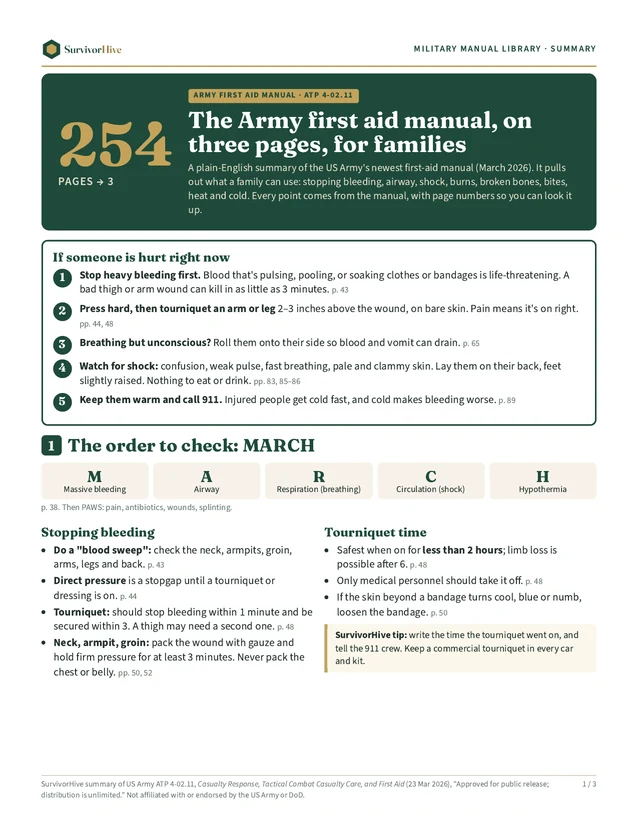
SurvivorHive Summary
3 printable pages: the MARCH order, bleeding and shock, burns, breaks, bites, heat and cold, with page numbers.
Get it free by email →If someone is hurt right now
- Stop heavy bleeding first. Blood that's pulsing, pooling or soaking through is life-threatening and comes before everything else. p. 43
- Press hard, then use a tourniquet on an arm or leg. Place it two to three inches above the wound, on bare skin. Pain means it's working. p. 44 p. 48
- Unconscious but breathing? Roll them onto their side. The recovery position lets blood and vomit drain. p. 65
- Watch for shock. Confusion, a weak pulse, fast breathing, and pale, clammy skin. Lay them on their back with feet raised, and give nothing to eat or drink. p. 83 p. 85 p. 86
- Keep them warm and call 911. Injured people get cold fast, even in mild weather, and cold makes bleeding worse. p. 89
What this manual is, and what it isn't
ATP 4-02.11 is the Army's main reference for responding to casualties. It's built around Tactical Combat Casualty Care (TCCC), the military's version of pre-hospital emergency care. p. 19 It's written for soldiers and the civilians who work with them. p. ix It isn't a first-aid course, and it doesn't replace one.
The manual is in three parts: casualty response, combat casualty care, and everyday first aid such as bites, heat and cold. p. xi Here's how its main terms translate for a family:
| The Army calls it | What it means for you |
|---|---|
| Care Under Fire | The danger is still there. Get safe, and only stop major bleeding. p. 31 |
| Tactical Field Care | You're safe now. Check the whole person and treat what you find. |
| Tactical Evacuation | Getting them to a hospital. For you, that's calling 911. |
| MARCH-PAWS | The order to check: bleeding, airway, breathing, circulation, hypothermia, then pain, wounds, antibiotics and splints. p. 38 |
Ch. 3–4Stop the bleeding first: the MARCH orderThe order to check someone who's hurt, and why bleeding comes first.
The Army checks an injured person in a set order called MARCH: Massive bleeding, Airway, Respiration (breathing), Circulation and Hypothermia. p. 38 Bleeding comes first because it's the top cause of deaths that could have been prevented. A badly bleeding wound to the thigh or arm can kill in as little as three minutes. p. 43
How to tell bleeding is life-threatening
- Blood that's pulsing or flowing steadily from the wound
- Blood pooling on the ground, or clothes soaked with blood
- Bandages that keep soaking through
- A partly or fully lost arm or leg
- Someone who bled a lot earlier and now shows signs of shock
Check the whole body for hidden bleeding with a quick "blood sweep": the neck, armpits, groin, arms, legs and back. p. 43
What the manual says to do
- Press hard on the wound while you get a tourniquet or dressing ready. Pressure alone is a stopgap, not the fix. p. 44
- Arm or leg: use a tourniquet two to three inches above the wound, directly on the skin, not over clothing. If bleeding doesn't stop, a second tourniquet may be needed, especially on the thigh. p. 48
- Expect it to hurt. The manual says pain is a sign the tourniquet is on correctly. It should stop the bleeding within one minute and be fully secured within three. p. 48
- Neck, armpit or groin (where a tourniquet won't fit): pack the wound with gauze, then hold firm pressure for at least three minutes. p. 52 Don't pack wounds of the chest or belly. p. 50
- Watch the bandage. If the skin beyond it turns cool, blue or numb, or you can't feel a pulse there, loosen it. p. 50
For a soldier
Under fire, a soldier puts a "hasty" tourniquet high and tight on the limb, over the uniform, in under a minute, then gets to cover. p. 43 p. 44For your family
Once you're safe, you have time to do it the deliberate way: expose the wound and place the tourniquet two to three inches above it, on bare skin. p. 48Ch. 5–6Airway and breathingWhat to do when someone is unconscious, and how to place them.
- Check if they respond. Gently shake them and ask, "Are you OK?" If they don't answer, call for help. p. 60
- Open the airway with a head-tilt, chin-lift. If you suspect a neck injury, use the jaw-thrust instead. Don't do a blind finger sweep of the mouth. p. 63
- Face injury but awake? Let them sit up and lean forward so blood drains out instead of down. p. 64
- Breathing but unconscious? Put them in the recovery position, on their side, so blood, mucus or vomit can drain and isn't breathed in. p. 65
The recovery position, step by step
Roll the person onto their side as a single unit, with their hand under their chin and their upper leg bent to keep them from rolling. p. 75
An open wound to the chest is covered with an airtight dressing, called a chest seal, to keep air from being pulled into the chest. p. 73
For a soldier
Combat lifesavers and medics carry airway tubes, a bag-valve mask and chest seals, and train on more advanced skills. p. 73For your family
Most of what you need is positioning: open the airway, roll them onto their side, and call 911. That works with no gear at all.Ch. 7Shock: expect it, prevent itSigns of shock, and the simple position that helps.
Shock means the body isn't getting enough blood flow. Severe bleeding is the most common cause, and second- or third-degree burns covering 20% or more of the body can cause it too. Bleeding inside the body can't be controlled in the field, so it needs fast transport to a hospital. p. 83
Signs of shock
- Confusion, or seeming out of it
- A weak or missing pulse at the wrist
- Fast breathing, nausea and heavy thirst
- Sweaty, cool, clammy, pale or gray skin
What to do
- Control the bleeding. It's the best way to prevent shock. p. 85
- Lay them on their back with their feet raised slightly above the heart, on something like a pack, log or box. Let them sit up if that helps them breathe. Move them into the shade if it's hot. p. 85
- Loosen tight clothing, and wrap them in a blanket so no part of them touches the ground. Don't let them get chilled or overheated. p. 85
- Take charge calmly. Reassure them and show confidence. p. 86
- Nothing to eat or drink. If they're unconscious or you have to leave them, turn their head to the side so they won't choke if they vomit. p. 86