
The UK military cold injury guide, in plain English for families
JSP 375 is the UK Ministry of Defence's health and safety handbook, and Chapter 42 is its cold injury policy. The chapter itself is mostly rules for commanders. Its annexes are where the practical advice lives: an individual's guide with step-by-step first aid for hypothermia, frostbite and non-freezing cold injury, and a commander's guide that explains the risk factors. We summarized all three.
Quick facts
| Full title | JSP 375, Management of Health and Safety in Defence, Volume 1, Chapter 42: Cold injury prevention |
| Published by | UK Ministry of Defence, on GOV.UK |
| Date | Chapter v1.4 (December 2024); Annex A v1.4 (November 2024); Annex B v2.1 (November 2022) |
| Length | Chapter 18 pages; Annex A 30 pages; Annex B 8 pages |
| Written for | UK Defence commanders, managers and individuals |
| Free to share? | Yes, under the Open Government Licence v3.0 |
| Best for families | Annex B, the individual's guide (PDF), and the risk factors in Annex A (PDF) |
| Safe to skip | The chapter's policy statements, risk-assessment forms and reporting rules |
The official UK Ministry of Defence manual
The full JSP 375 Vol 1 Ch 42, Chapter 42 itself, an unchanged copy of the GOV.UK file hosted by SurvivorHive. The annexes are linked below. Free, no email needed.
⬇ Download the official PDF (1 MB)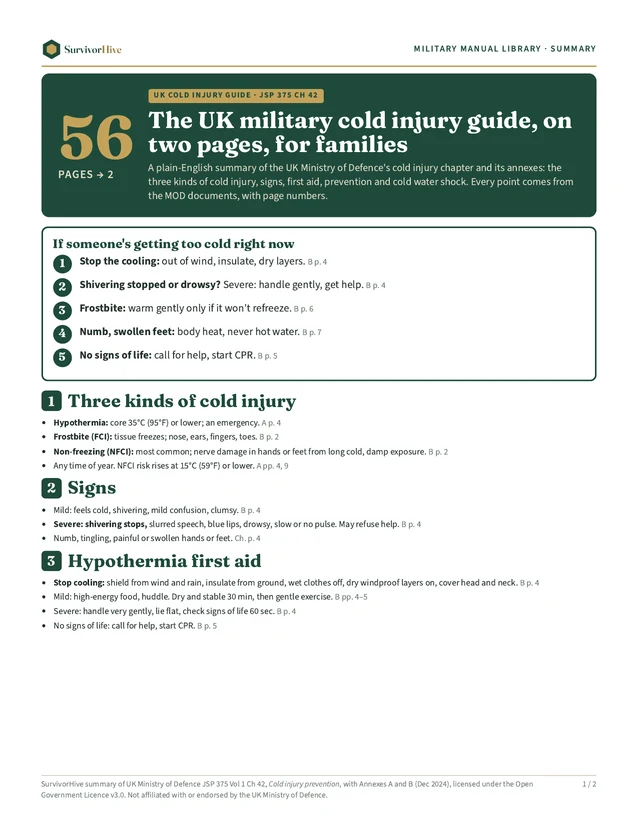
SurvivorHive Summary
2 printable pages: the three kinds of cold injury, signs, step-by-step first aid, COLD FEET prevention and cold water shock, with page numbers.
Get it free by email →If someone's getting too cold right now
- Stop the cooling. Out of wind and rain, insulation under them, wet clothes off, dry windproof layers on, head covered. Annex B, p. 4
- Shivering stopped, confused or drowsy? That's moderate or severe hypothermia. Handle gently, keep them flat and get emergency help. Annex B, p. 4
- White, waxy, hard skin? Warm it in armpits or under hands only if it won't refreeze. No rubbing, no direct heat. Annex B, p. 6
- Numb, swollen feet after a cold, wet day? Warm them with body heat; never hot water or a fire. Annex B, p. 7
- No signs of life? Call for help and start CPR. Annex B, p. 5
What this manual is, and what it isn't
Chapter 42 sets out the MOD's cold injury policy: five policy statements for commanders on planning, risk assessment, monitoring, reporting and training. Ch. 42, p. 6 Its guidance is in seven annexes on GOV.UK. We used the two written for real-world prevention and first aid:
- Annex A, Commander's Guide to Cold Injury Prevention (30 pages): types of cold injury, risk factors and the wind chill table. PDF
- Annex B, Individual's Guide to Preventing Cold Injury (8 pages): prevention and first aid flowcharts. PDF
- The other annexes (risk controls, hand and foot inspections, the NFCI field assessment tool and employment rules) are on the GOV.UK page.
| The MOD says | What it means for you |
|---|---|
| FCI | Freezing cold injury: frostnip and frostbite |
| NFCI | Non-freezing cold injury, sometimes called trench foot or immersion foot |
| Huddle | Warm people sharing body heat around the casualty |
Ch. 42Cold injury happens above freezingThree kinds, all year round.
The MOD splits cold injury into three kinds, and they can happen together. Ch. 42, p. 4
| Injury | What it is |
|---|---|
| Hypothermia | Core temperature of 35°C (95°F) or lower. A medical emergency that can kill. Annex A, p. 4 |
| Freezing cold injury (FCI) | Frostnip and frostbite: skin, sometimes deeper tissue, actually freezes. Noses, ears, fingers and toes go first. Annex B, p. 2 |
| Non-freezing cold injury (NFCI) | Nerve and blood-vessel damage in hands or feet from long, cold, often damp exposure. The most common cold injury, and it doesn't need freezing temperatures. Ch. 42, p. 4 Annex B, p. 2 |
- Cold injury can happen any time of year, not just winter. Annex A, p. 4
- NFCI risk rises at 15°C (59°F) or lower; frostbite risk at about −0.5°C (31°F) and lower. Annex A, p. 9
- Even deserts can get cold enough at night. Ch. 42, p. 8
- Hypothermia can creep up slowly on a cold, wet day, or come on fast in cold water or extreme cold. It's also a risk for anyone badly injured, in any climate. Annex B, p. 2
Ch. 42 & Annex BSigns to watch forIn yourself and in others.
- Cold to the touch, shivering, slurred speech, blue lips, much paler skin than normal. Ch. 42, p. 4
- Apathy, confusion or irrational behavior. People with hypothermia may deny there's a problem and refuse help. Ch. 42, p. 4 Annex B, p. 4
- No feeling in a body part, or a part that feels cold and hard. Ch. 42, p. 4
- Numbness, tingling, pain or swelling in hands or feet. Ch. 42, p. 4
| Mild hypothermia | Moderate or severe hypothermia |
|---|---|
| Says they feel cold; cold to touch; uncontrolled shivering; mild confusion or irritability; clumsiness | Slurred speech; blue lips; shivering has stopped; confused or irrational; drowsy or unresponsive; slow, irregular or no pulse; may look dead |
Annex BFirst aid: hypothermiaStop the cooling, then warm gently.
- Stop the activity, move them out of danger and check airway, breathing and circulation. Annex B, p. 4
- Stop further cooling: shield them from wind and rain, put insulation between them and the ground, remove wet clothes, add dry, warm, windproof layers, and cover the head and neck. Annex B, p. 4
- Mild: give high-energy food like chocolate and huddle around them. Once they're dry and stable for at least 30 minutes, gentle exercise helps. Get them somewhere heated. Annex B, p. 4 Annex B, p. 5
- Moderate or severe: handle them very gently and keep them lying flat. Check for signs of life for at least 60 seconds. Annex B, p. 4
- No signs of life? Call for emergency help immediately and start CPR, unless it's unsafe or clearly hopeless. Keep preventing cooling as long as it doesn't get in the way of CPR. Annex B, p. 5
- Every case needs emergency care. Annex B, p. 5
Annex BFirst aid: frostbiteGentle warmth, and only if it won't refreeze.
- Suspect frostbite when skin is white and waxy with a clear border, painless and numb, or cold and hard. Warming skin may blister and bruise. Annex B, p. 6
- Treat any hypothermia first, and stop further cooling. Annex B, p. 6
- If there's any risk it will freeze again, don't warm it. Get them to a heated place and medical care. Annex B, p. 6
- Otherwise warm the part under your hands, in your lap or in their armpits. Annex B, p. 6
- Don't use direct heat, hot water or stoves, rub it, use heat ointment, or let them smoke or drink alcohol. Don't let them use the limb once it's warmed unless they must. Annex B, p. 6
- Replace wet socks or gloves, cover blisters lightly, and give warm non-alcoholic drinks or high-energy food. Annex B, p. 6