
The Army Ranger Handbook: the parts a family can use
TC 3-21.76, the Ranger Handbook, is the pocket guide every Ranger student carries. Nearly all of it is about combat, and you can skip that. But a handful of its habits translate straight to a family: planning backward, the GOTWA plan for when someone leaves, rally points, a layered backup contact plan, and the order to work in when someone is badly hurt.
Quick facts
| Full title | TC 3-21.76, Ranger Handbook |
| Published by | Headquarters, Department of the Army |
| Date | 19 September 2025 · listed as Active, the current edition |
| Length | 380 PDF pages: 15 chapters and 2 appendices |
| Written for | Ranger students and small-unit leaders |
| Free to share? | Yes. Approved for public release; distribution is unlimited cover |
| Replaced | TC 3-21.76, dated 26 April 2017 cover |
| Best for families | Planning (ch. 2), GOTWA, rally points and PACE (ch. 7), casualty care (ch. 15) |
| Safe to skip | The combat chapters: patrols, fire support, demolitions and battle drills |
The official Army manual
The full TC 3-21.76, straight from the Army Publishing Directorate. Free, no email needed.
⬇ Download the official PDF (38 MB)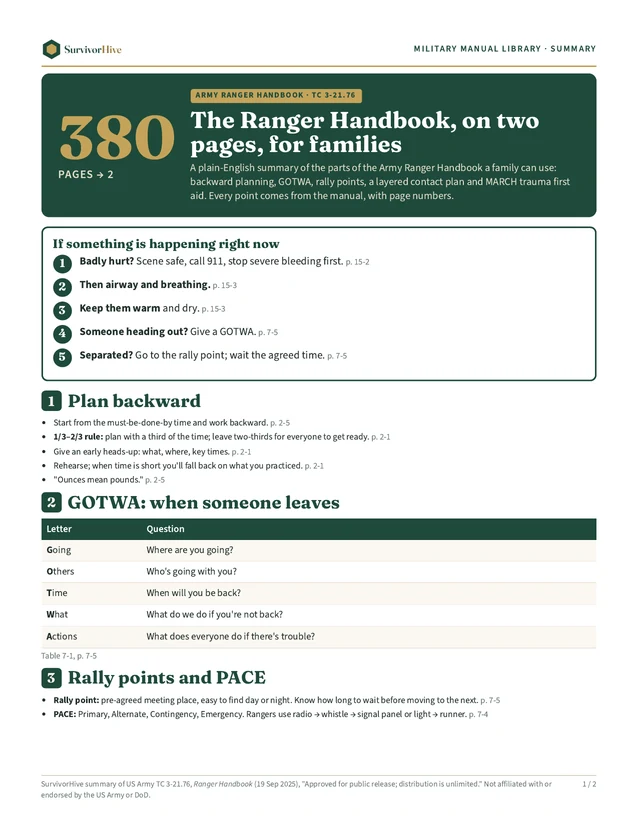
SurvivorHive Summary
2 printable pages: backward planning, GOTWA, rally points, a PACE contact plan and MARCH first aid, with page numbers.
Get it free by email →If something is happening right now
- Someone badly hurt? Make the scene safe, call 911, and stop severe bleeding first, with a tourniquet if it's an arm or leg. p. 15-2
- Then airway and breathing. Chin lift to open the airway; let them breathe in the easiest position. p. 15-3
- Keep them warm. Dry and covered, even in mild weather. Shock and cold go together. p. 15-3
- Someone heading out? Give a GOTWA: going where, with whom, back when, what if not, and what to do if there's trouble. p. 7-5
- Separated? Go to the agreed rally point and wait the agreed time. p. 7-5
What this manual is, and what it isn't
The Ranger Handbook covers leadership, operations and planning, communications, movement, patrols, mountaineering, waterborne operations, aviation and tactical combat casualty care, along with combat topics. contents We've summarized only the parts that make sense for a family: planning, staying together, communicating and first aid.
| The Army calls it | What it means for you |
|---|---|
| Warning order | An early heads-up so people can start getting ready. p. 2-1 |
| GOTWA | A five-point plan whenever someone leaves the group. p. 7-5 |
| Rally point | A pre-agreed meeting place if you get separated. p. 7-5 |
| MARCH | The order to treat a badly injured person. p. 15-2 |
Ch. 2Plan backward, and give people timeHow Rangers plan, scaled down to a family.
Ranger leaders start from the time something must be done and plan backward from there. p. 1-2 p. 2-5 They use the 1/3–2/3 rule: the leader takes no more than a third of the available time to plan, leaving two-thirds for everyone else to get ready. p. 2-1
- Give a heads-up early. A warning order goes out as soon as possible with the basics: what's happening, where, and the key times, so people can start preparing. p. 2-1
- Rehearse. When time is short, leaders rely on actions they've already rehearsed. p. 2-1
- Pack smart. "Ounces mean pounds, and pounds impact performance." Weigh carrying too much against carrying too little. p. 2-5
For a soldier
Leaders follow eight troop leading procedures, from receiving the mission through issuing orders and supervising. p. 2-1For your family
For a family, the useful idea is simple: tell everyone early, decide when you have to leave, work backward, and practice the plan before you need it.Ch. 7GOTWA: when someone leaves the groupA five-point plan that answers the scary questions in advance.
Every time a Ranger leader leaves the main group, the person left in charge gets a five-point contingency plan, remembered as GOTWA. p. 7-4
| Letter | The question it answers |
|---|---|
| Going | Where is the leader going? |
| Others | Who is going with the leader? |
| Time | How long will they be gone, or when will they return? |
| What | What should happen if they don't return? |
| Actions | What does everyone do if something goes wrong? |
Table 7-1, p. 7-5. The manual's last line covers enemy contact; for families, think "if there's trouble."
Ch. 7Rally points and a backup contact planWhere to meet, and how to reach each other when phones fail.
A rally point is a place picked in advance for a separated group to meet up again. Everyone knows which one to use, what to do there, and how long to wait before moving to the next one. A good rally point is easy to recognize in daylight and in the dark. p. 7-5
The PACE plan
Rangers plan four layers of communication: Primary, Alternate, Contingency and Emergency. The Ranger Course uses radio first, then whistle blasts, then a signal panel by day or a light by night, and finally a runner. p. 7-4
| Layer | A family version (our suggestion) |
|---|---|
| Primary | Cell phone call or text |
| Alternate | Text an out-of-state relative who relays messages |
| Contingency | A note left at home, or a whistle signal nearby |
| Emergency | Go to the agreed rally point and wait the agreed time |
Ch. 15Trauma first aid, in Ranger orderThe order to work in when someone is badly hurt.
Ranger casualty care targets the most common preventable causes of death from injury: severe bleeding, a collapsed lung and airway problems. The manual notes its phases apply to noncombat injuries too. p. 15-1 First, make sure the scene is safe. Then work in MARCH order: p. 15-2
| Step | What to do |
|---|---|
| Massive bleeding | Spurting or steady bleeding from an arm or leg: put on a tourniquet without delay, high and tight. If it doesn't stop, add a second above the first. Use pressure dressings for other bleeding. p. 15-2 |
| Airway | Open it with a chin lift, or a jaw thrust if the face or head is injured. p. 15-3 |
| Respiration | Trouble breathing: look for chest wounds; seal open chest wounds with a vented chest seal. Let them lie on the injured side or however breathing is easiest. p. 15-3 |
| Circulation | Recheck tourniquets and treat for shock. p. 15-2 p. 15-3 |
| Hypothermia / head | Get them dry and warm with blankets or a sleeping bag; watch a head injury for growing confusion. p. 15-3 |
Signs of shock: cool, clammy, pale skin; restlessness or agitation; unusual thirst; confusion; fast breathing; bluish skin around the mouth; nausea. p. 15-3
Ch. 15Water and sanitation in the fieldThe Ranger way to make water safe.
- Fill with the cleanest, clearest water you can find. Add 2 iodine tablets per quart (or 5 drops of 2% tincture of iodine per tablet). p. 15-13 p. 15-14
- Shake, wait 5 minutes, loosen the cap and tip it so treated water rinses the threads, then tighten and wait another 25 minutes. p. 15-14
- For a group staying put up to 3 days, a straddle trench latrine is 1 foot wide, 2½ feet deep and at least 4 feet long. p. 15-14