
The Army Mountaineering Manual, in plain English for families
TC 3-97.61 is the Army's 432-page guide to operating in the mountains. Most of it, from rock and ice climbing to rope systems, is technical training you shouldn't learn from a book. But a few chapters are worth any family's time before a mountain trip: weather and lightning, altitude sickness, avalanche warning signs, stream crossings and safe walking.
Quick facts
| Full title | TC 3-97.61, Military Mountaineering |
| Published by | Headquarters, Department of the Army |
| Date | 26 November 2025 · listed as Active, the current edition |
| Length | 432 PDF pages: 16 chapters |
| Written for | Soldiers training and operating in mountains |
| Free to share? | Yes. Approved for public release; distribution is unlimited cover |
| Replaced | TC 3-97.61, dated 26 July 2012 cover |
| Best for families | Weather (ch. 1), altitude (ch. 3), avalanches (ch. 5), walking (ch. 6), streams (ch. 13) |
| Safe to skip | Climbing, ropes, rappelling and hauling systems: take a hands-on course instead |
The official Army manual
The full TC 3-97.61, straight from the Army Publishing Directorate. Free, no email needed.
⬇ Download the official PDF (34 MB)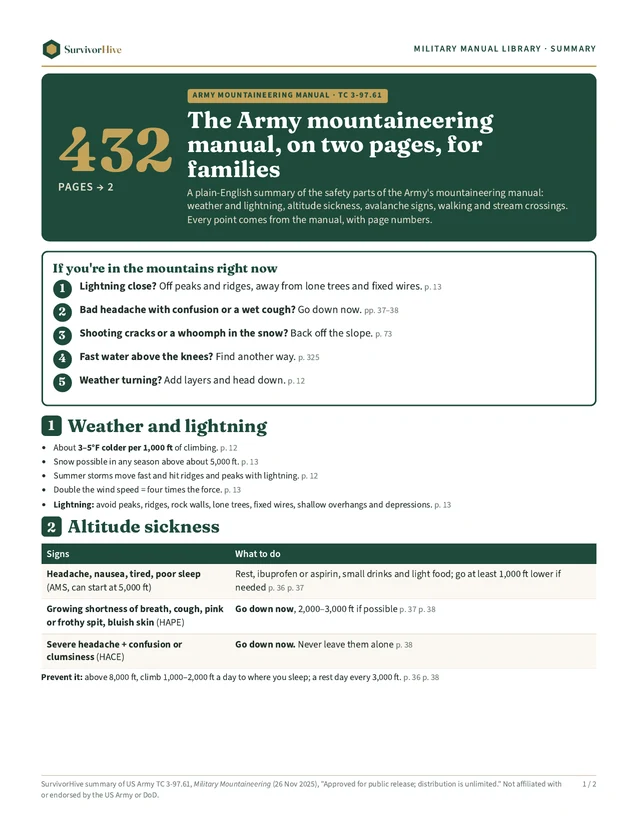
SurvivorHive Summary
2 printable pages: mountain weather, lightning, altitude sickness, avalanche signs and stream crossings, with page numbers.
Get it free by email →If you're in the mountains right now
- Lightning close? Get off peaks and ridges and away from lone trees, rock walls and fixed wires. p. 13
- Bad headache with confusion or a wet cough? Those can be serious altitude illness. Go down immediately and get help. p. 37 p. 38
- Cracks shooting out or a "whoomph" in the snow? That's an avalanche warning. Back off that slope. p. 73
- Fast water above the knees? Find another place or another route. p. 323 p. 325
- Weather turning? Temperatures drop 3–5°F per 1,000 feet and storms move fast. Add layers and head down. p. 12
What this manual is, and what it isn't
TC 3-97.61 covers the mountain environment and weather, mountaineer training, environmental injuries, sustainment, avalanches, mobility, navigation, knots and rope work, anchors and climbing rope systems, stream crossings, glacier travel, mountain rescue and rope bridges. contents For families, the parts on weather, altitude, avalanches, walking and streams are the ones to read.
| The Army calls it | What it means for you |
|---|---|
| AMS | Acute mountain sickness: the common altitude headache and nausea. p. 36 |
| HAPE | Fluid in the lungs at altitude: an emergency. p. 37 |
| HACE | Brain swelling at altitude: an emergency. p. 38 |
| Critical loading | Snow piling up fast enough to raise avalanche danger. p. 65 |
Ch. 1Mountain weather and lightningWhy the mountains change fast.
- Air gets about 3 to 5°F colder for every 1,000 feet you climb. p. 12
- Snow can fall in any season above about 5,000 feet. p. 13
- Summer thunderstorms move fast and hit exposed ridges and peaks with lightning. p. 12
- Wind is stronger on ridges and passes; when wind speed doubles, its force on you quadruples. p. 13
- Rain makes rock slick and raises the risk of falls and rockfall in gullies. p. 12
When lightning is near
Lightning usually strikes high points and prominent features. Stay away from peaks, ridges, rock walls, isolated trees, fixed wires or cables, water-filled cracks, shallow overhangs and shallow depressions. p. 13
For a soldier
Soldiers often have to go regardless; the manual notes civilian climbers plan around "weather windows" for flexibility. p. 12For your family
You usually can choose. Check the forecast, start early, and turn around when clouds build. The manual's four questions help: what's the weather now, what was it recently, when's the next change, and how does it affect us? p. 14Ch. 3Altitude sicknessHeadaches, nausea, and the warning signs that mean go down now.
Acute mountain sickness (AMS) can strike at altitudes as low as 5,000 feet, regardless of experience. p. 36 Symptoms like headache, nausea, fatigue, dizziness, poor sleep and loss of appetite can begin 4 to 12 hours after arriving. They usually peak by the second day and fade over the next several days. p. 36 p. 37
| Problem | What to do (per the manual) |
|---|---|
| Mild AMS | Rest, pain relievers such as ibuprofen or aspirin, frequent small drinks and light food, deep breathing, and going lower (at least 1,000 feet) if needed. p. 37 |
| Growing shortness of breath, a cough, frothy or pink spit, a bluish face or hands (HAPE) | Go down immediately, 2,000 to 3,000 feet if possible. Rest and oxygen if available. p. 37 p. 38 |
| Severe headache with confusion, clumsiness or odd behavior (HACE) | Go down immediately. Never leave the person alone; they're often mistaken for being irritable. p. 38 |
Prevention: above 8,000 feet, climb only 1,000 to 2,000 feet per day to where you sleep, and take a rest day for every 3,000 feet gained. Stay fed and hydrated. p. 36 p. 38
Ch. 5Avalanche warning signsFor winter hikes, snowshoe trips and mountain roads.
The manual treats these as clear signs of immediate danger on similar slopes: p. 73
- Recent avalanches on similar slopes
- Shooting cracks running out from your feet
- "Whoomphing": hollow collapsing sounds in the snow
Avoid avalanche terrain when snow is piling up fast: more than 1 inch an hour or more than 1 foot in 24 hours. Rain, new wind-blown snow, and a rapid rise in temperature also raise the danger. p. 65 p. 73
If you are caught
- Try to get out the side of the slide. p. 74
- Ditch gear and swim to stay near the surface. p. 74
- If your head goes under, close your mouth and use an elbow to make an air pocket in front of your face; reach for the surface with the other arm. p. 74
Ch. 13Crossing a streamCold, fast water is stronger than it looks.
The force of flowing water is often underestimated. Treat streams as danger areas and avoid crossing when you can; if water is too wide, fast or deep, find another route. p. 323
- Pick the spot: where the stream widens and is shallower. Avoid bends, narrow chutes, and anything upstream of rapids, falls or fallen trees. p. 323 p. 324
- Depth: about knee height or below, with a mild to moderate current. p. 325
- Pack: worn snug, with waist and chest straps unbuckled so you can shed it if swept off your feet. Bag dry clothes in a trash bag. p. 324
- Move: face slightly into the current, angle a little downstream, take small steps, lead with the downstream foot, and don't cross your legs. Step on the upstream side of rocks. p. 325
- Use a stick planted upstream as a third leg. p. 325
Ch. 6Walking on rough groundFooting and packs on mountain trails.
- Most mountain travel only needs good walking skills: choosing where to step and keeping your balance on each step. p. 84