
The Army Foot Marches Manual, in plain English for families
ATP 3-21.18 is how the Army plans and runs foot marches. Much of it covers organizing units and security, which you can skip. But it's also full of tested numbers that matter if your family ever has to walk home or walk out: how far you can get in an hour, when to rest, how heavy a pack should be, how to drink, and how to keep feet working.
Quick facts
| Full title | ATP 3-21.18, Foot Marches |
| Published by | Headquarters, Department of the Army |
| Date | 24 July 2025 · listed as Active, the current edition |
| Length | 168 PDF pages: 3 chapters and 6 appendices |
| Written for | Leaders and soldiers planning foot marches |
| Free to share? | Yes. Approved for public release; distribution is unlimited cover |
| Replaced | ATP 3-21.18, dated 13 April 2022 cover |
| Best for families | Pace and rest (ch. 1), pack weight (ch. 3 and appendix C), foot care (appendix E) |
| Safe to skip | March organization, security, fire support and unit duties (ch. 2) |
The official Army manual
The full ATP 3-21.18, straight from the Army Publishing Directorate. Free, no email needed.
⬇ Download the official PDF (9 MB)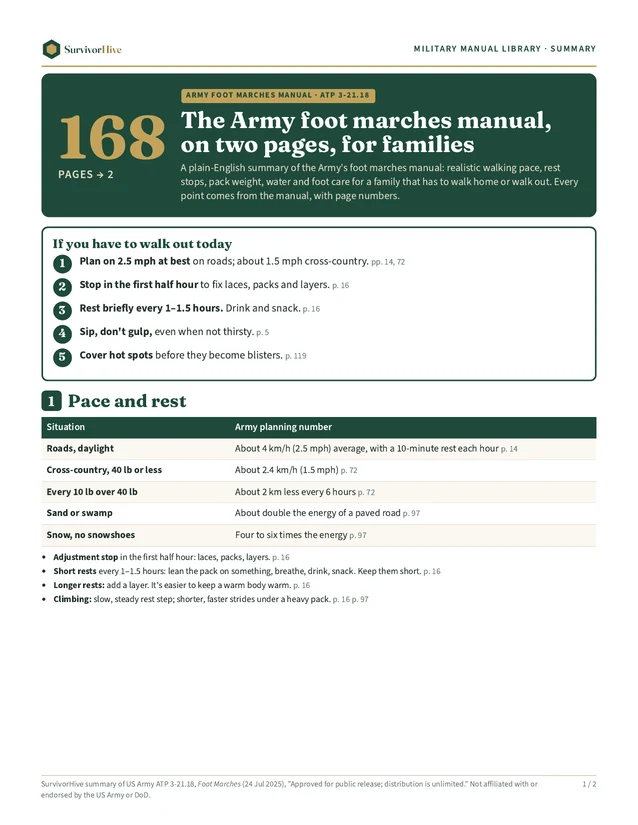
SurvivorHive Summary
2 printable pages: pace, rest stops, pack weight, water and blister care, with page numbers.
Get it free by email →If you have to walk out today
- Plan on about 2.5 mph at best. That's the Army's average on roads with rests; cross-country is closer to 1.5 mph. p. 14 p. 72
- Stop in the first half hour. Fix laces, packs and layers before small problems grow. p. 16
- Rest briefly every hour or so. Take the weight off, drink, snack, and keep it short. p. 16
- Sip, don't gulp. Drink small amounts often, even when not thirsty. p. 5
- Cover hot spots right away. A warm, red, burning patch is a blister on its way. p. 119
What this manual is, and what it isn't
A foot march is a movement of troops on foot. The manual covers movement basics and planning, running the march, soldier load, and appendices on body mechanics, training, foot care, and related injuries. contents For a family, the useful parts are the planning numbers, rest and pace, pack loading, water, and foot care.
| The Army calls it | What it means for you |
|---|---|
| Rate of march | Average speed, counting rest stops. p. 14 |
| Adjustment halt | A quick early stop to fix laces, packs and layers. p. 16 |
| Rest step | A slow, steady climbing step with a brief pause. p. 16 |
| Hot spot | The warm, red patch before a blister. p. 119 |
Ch. 1 & 3How far and how fastRealistic numbers for walking out.
If you ever have to walk home or walk out, the Army's planning numbers are a good reality check. On roads in daylight, soldiers march about 4.8 km/h but average 4 km/h (about 2.5 mph) once a 10-minute rest every hour is counted. p. 14 Cross-country, the sustainable rate drops to about 2.4 km/h (about 1.5 mph) with a load of 40 pounds or less. p. 72
| What slows you down | What the manual says |
|---|---|
| Heavier loads | Every 10 lb over 40 lb cuts the distance covered by about 2 km every 6 hours. p. 72 |
| Sand or swamp | About doubles the energy cost of walking on a paved road. p. 97 |
| Snow without snowshoes | Four to six times the energy cost. p. 97 |
| Hills | Slopes of 7 percent or more slow movement, uphill or downhill. p. 4 |
For a soldier
Soldiers plan march rates so they keep an energy reserve, aiming to stay around 300 kilocalories an hour. p. 72For your family
Your family will move slower than a trained unit, especially with kids. Plan on less than these numbers and leave early.Ch. 1 & App. CRest stops that workWhen to stop, and for how long.
- Stop early once. Take an adjustment halt in the first half hour to fix laces, packs and layers. p. 16 The manual also says to stop briefly after the first mile to retie boots. p. 97
- Short rests every 1 to 1.5 hours. Lean against a tree, rock or hillside to take the pack's weight off, breathe deeply, drink and snack. Keep these short so muscles don't stiffen. p. 16
- Longer rests: put on a layer so you don't get chilled. "It is much easier to keep a warm body warm, than to warm up a cold body." p. 16
- On climbs, use the rest step: a slow, steady pace with a brief pause on the straight back leg each step beats spurts of speed. p. 16
- Under a heavy pack, take shorter, faster strides. p. 97
Ch. 3 & App. CPacking the bagHow much to carry and where to put it.
The manual's research found that with loads up to 30 percent of body weight, energy use stays steady; above 30 percent, it keeps climbing through the march. p. 97
- Heavy items high and close to your back. That can cut the energy cost of carrying by as much as 25 percent compared with heavy items low and away from the body. p. 97 p. 98
- Ounces add up to pounds, and pounds affect how well you move. p. 10
For a soldier
Soldiers' loads are planned by leaders and tied to the mission; the manual's tables run up to 45 percent of body weight for an approach march. p. 76For your family
For a family go-bag, the 30 percent line is a ceiling, not a target. Pack the heavy water and food high and tight, and carry only what you'd really use.Ch. 1Water on the moveThe Army's rules for drinking while walking.
- Drink before, during and after the walk, but don't overhydrate. p. 5
- Drink small amounts slowly, rather than gulping, even when you're not thirsty. p. 5
- Drink treated water, and refill at every chance. p. 5
- Don't force-drink plain water alone; the body also needs salt and nutrients, which normally come from food. p. 5 p. 6
- Dehydration is as much a danger in the cold as in the heat; sweat just hides in your layers. p. 6
- If pure water isn't available, treat it with purification tablets. p. 6
App. EFeet and blistersThe most common problem on any long walk.
Blisters and abrasions are the most common load-related injury, and they come from friction between socks and skin. p. 119
Before and during
- Cut toenails short and straight across. p. 117
- Wear clean, dry, well-fitting socks; liners can reduce friction. Change wet socks as soon as possible. p. 117
- Break in new boots by alternating with an old pair, and tape known hot spots first. p. 118
- At rests, take off one boot at a time to check feet and change socks. p. 118
- A hot spot (a warm, burning, red patch) is a blister about to form. Cover it right away. p. 119
- Moleskin can be used to prevent blisters before you set out. p. 120
Treating a blister
- Wash gently around it with soap and water without breaking the skin. p. 120
- If unbroken, drain it at the lower edge with a needle sterilized in a flame or with alcohol. Leave the skin on and cover it with an absorbent bandage that extends past the edges. p. 120
- A torn blister: remove the top, use antibiotic ointment and a bandage.