
The Army desert manual, in plain English for families
ATP 3-90.99 (the Marine Corps calls it MCTP 12-10D) is the military's desert handbook. Most of it is about military operations, but its first chapter and an appendix are a clear guide to what the desert does to people and vehicles: water, heat, sun, sandstorms, freezing nights, flash floods, snakes and scorpions, and getting a car unstuck. That's the part we summarized.
Quick facts
| Full title | ATP 3-90.99 / MCTP 12-10D, Desert Operations |
| Published by | Headquarters, Department of the Army, and Headquarters, US Marine Corps |
| Date | 7 April 2021, incorporating Change 1 (24 June 2025) · listed as Active |
| Length | 180 PDF pages: 7 chapters and 4 appendices |
| Written for | Army and Marine Corps leaders and troops |
| Free to share? | Yes. Approved for public release; distribution is unlimited cover |
| Replaced | FM 90-3/FMFM 7-27, dated 24 August 1993 cover |
| Best for families | The desert environment and its effects on people (ch. 1) and driving in the desert (app. B) |
| Safe to skip | Chapters 2 to 7: military planning, operations and training |
The official Army and Marine Corps manual
The full ATP 3-90.99 / MCTP 12-10D, an unchanged copy of the Army Publishing Directorate file, hosted by SurvivorHive. Free, no email needed.
⬇ Download the official PDF (4 MB)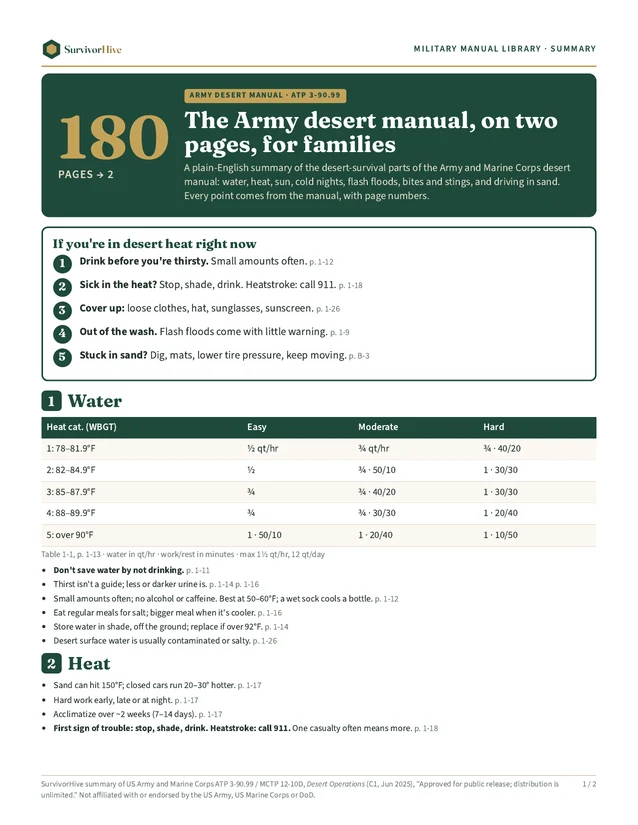
SurvivorHive Summary
2 printable pages: water and heat tables, sun and sandstorms, flash floods, snakes and scorpions, and getting a car unstuck, with page numbers.
Get it free by email →If you're in desert heat right now
- Drink before you're thirsty. Small amounts often. Less urine or darker urine means drink more. p. 1-12 p. 1-16
- Feeling sick in the heat? Stop, get into shade and drink. Heatstroke is an emergency: call 911. p. 1-18
- Stay covered. Loose clothes, sleeves down, hat, sunglasses and sunscreen. p. 1-25 p. 1-26
- Get out of the wash. Dry riverbeds can flood with little warning. p. 1-9
- Stuck in sand? Dig a gentle slope, mats under the wheels, lower tire pressure, keep moving to firm ground. p. B-3
What this manual is, and what it isn't
ATP 3-90.99 / MCTP 12-10D covers the desert environment, the foundations of desert operations, offense, defense, stability operations and training, plus appendices on desert regions of the world and operating equipment in the desert. contents Chapter 1 is the part written about people: what heat, cold, sun, wind and wildlife do to the body and how to protect against them. p. 1-1
| The manual calls it | What it means for you |
|---|---|
| WBGT index | Wet bulb globe temperature: a heat measure that includes humidity, sun and wind. p. 1-13 |
| Acclimatization | Your body getting used to heat over one to two weeks. p. 1-17 |
| Hyponatremia | A dangerous drop in the body's salt from drinking too much water. p. 1-12 |
| Mired vehicle | A stuck vehicle. p. B-3 |
Ch. 1Water: the whole game in the desertHow much to drink, and how to keep it safe.
The manual calls drinking water the most important requirement in the desert. People can live longer without food than without water, so carry as much as you can whenever you're away from a safe source. p. 1-11 p. 1-12
- Don't ration by not drinking. One of the biggest problems is people who realize how precious water is and stop drinking enough. p. 1-11
- Thirst isn't a good guide. People get dehydrated even when they drink when thirsty. Watch urine instead: less of it, and darker, are warning signs. p. 1-14 p. 1-16
- Drink smaller amounts often rather than a lot at once, which can cause nausea. Avoid alcohol and caffeine. p. 1-12
- Losing about 2 quarts of body fluid (2.5 to 3 percent of body weight) already impairs you: poor coordination, fatigue, trouble concentrating, headache. p. 1-13
- Water is easiest to drink at 50 to 60°F. A wet sock wrapped around a bottle cools it by evaporation. Sports drinks are optional; if you use them, mix 1:1 with water. p. 1-12
- Don't overdo it either. The manual's limits are 1½ quarts an hour and 12 quarts a day; drinking too much can cause hyponatremia, a dangerous loss of salt. p. 1-12 p. 1-13
- Eat regular meals. Food replaces the salt you sweat out, and heat kills appetite, so eat the bigger meal in the cooler part of the day. p. 1-16
| Heat category (WBGT) | Easy work | Moderate work | Hard work |
|---|---|---|---|
| 1: 78–81.9°F | ½ qt/hr | ¾ qt/hr | ¾ qt/hr, 40 min work / 20 rest |
| 2 (green): 82–84.9°F | ½ qt/hr | ¾ qt/hr, 50/10 | 1 qt/hr, 30/30 |
| 3 (yellow): 85–87.9°F | ¾ qt/hr | ¾ qt/hr, 40/20 | 1 qt/hr, 30/30 |
| 4 (red): 88–89.9°F | ¾ qt/hr | ¾ qt/hr, 30/30 | 1 qt/hr, 20/40 |
| 5 (black): over 90°F | 1 qt/hr, 50/10 | 1 qt/hr, 20/40 | 1 qt/hr, 10/50 |
Table 1-1, p. 1-13. WBGT is a heat index that includes humidity, sun and wind; it isn't the same as the air temperature. Easy work with no limit listed has no set work/rest cycle.
- Keep stored water in the shade and off the ground. A 5-gallon can heats to unpleasant temperatures in 3 to 4 hours of full sun, but 7 to 8 hours in shade. Heat also weakens chlorine. p. 1-14
- Store water only in clean containers meant for water. If stored water gets above 92°F, replace it; bacteria can multiply. p. 1-14
- Natural or standing water in the desert is usually contaminated and often too salty to drink. Disinfect anything you're unsure of. p. 1-26 p. 1-27
- When water is short, drinking comes first, then medical care, then vehicle cooling, then cooking, washing and laundry. p. 1-15
Ch. 1Heat: work early, rest in the shadeAcclimatizing, timing and the first signs of trouble.
- Heat from the sun, air and ground can easily push temperatures above 100°F. Sand in full sun is often 30 to 45 degrees hotter than the air, and can reach 150°F. Closed vehicles can run 20 to 30 degrees hotter than outside. p. 1-16 p. 1-17
- Do the hard work early in the morning, late in the evening or at night. Work in the heat of the day takes longer and wears people out faster. p. 1-17
- Getting used to heat takes about two weeks of gradually more exposure and effort. You get much of the benefit in 4 to 5 days; full acclimatization takes 7 to 14 days. It doesn't lower how much you need to drink. p. 1-17
- Being overweight, dehydrated, short on sleep, older, in poor health or drinking alcohol all raise the risk. p. 1-17
- At the first sign of heat illness, stop, get into shade and drink. Make shade with a tarp if there's none. p. 1-17 p. 1-18
- Heatstroke is a medical emergency. Get medical help immediately. And one heat casualty is often followed by others: check on everyone. p. 1-18
- Sweat in dry heat evaporates so fast your skin can look dry. Staying fully clothed keeps sweat on the skin longer, where it cools you. p. 1-12