
The Air Force survival handbook, in plain English for families
Air Force Handbook 10-644 is the Air Force's reference for survival, evasion, resistance and escape (SERE). We summarized only the environmental survival parts: keeping calm, cold and heat injuries, water, shelter, fire, signaling and when to stay put. We left out everything about evasion, resistance and captivity.
Quick facts
| Full title | Air Force Handbook 10-644, Survival Evasion Resistance Escape (SERE) Operations |
| Published by | Department of the Air Force |
| Date | 27 March 2017 · current on Air Force e-Publishing |
| Length | 652 PDF pages: 24 chapters |
| Written for | Air Force members who could become isolated |
| Free to share? | Yes. "There are no releasability restrictions on this publication." title page |
| What we covered | Psychology (ch. 4), medicine (ch. 5), body heat (ch. 11), shelter (ch. 13), fire (ch. 14), water (ch. 16), the stay-or-go decision (ch. 19), fording (ch. 20) and signaling (ch. 21) |
| What we skipped | Captivity, evasion, resistance and urban evasion (parts of ch. 3 and 4, and ch. 10, 22, 23 and 24) |
The official Air Force manual
The full AFH 10-644, an unchanged copy of the Air Force e-Publishing file, hosted by SurvivorHive. Free, no email needed.
⬇ Download the official PDF (45 MB)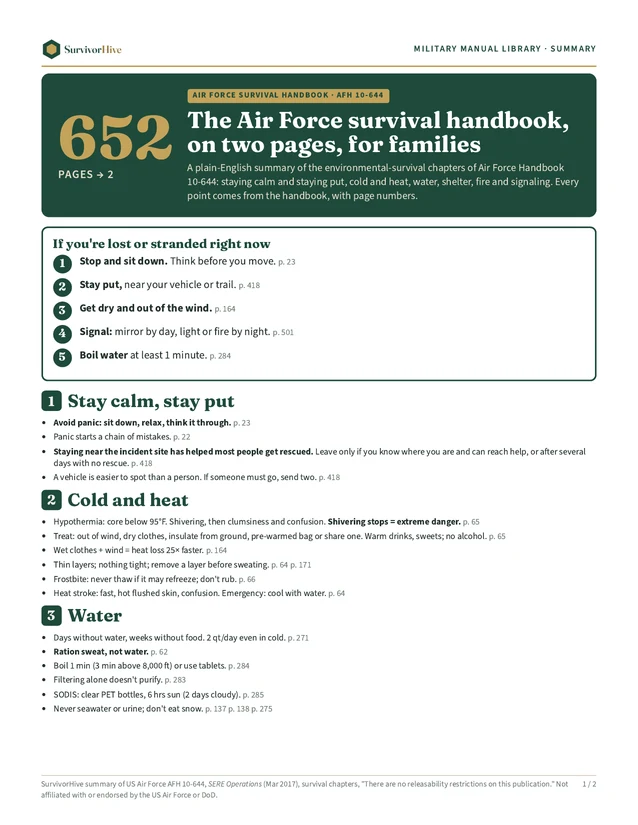
SurvivorHive Summary
2 printable pages: staying calm, hypothermia and heat stroke, water, shelter and fire, signaling and when to stay put, with page numbers.
Get it free by email →If you're lost or stranded right now
- Stop and sit down. Avoid panic and think it through before you move. p. 23
- Stay where you are. Most people are found near where things went wrong. Stay with your vehicle. p. 418
- Get dry and out of the wind. Wet clothes in wind lose heat about 25 times faster. p. 164
- Make yourself easy to see. Mirror flashes by day, light or fire by night. p. 501 p. 504
- Treat water before drinking. Boil at least 1 minute. Never seawater or urine. p. 284 p. 138
What this manual is, and what it isn't
AFH 10-644 is the Air Force's main SERE reference, describing "the various environmental conditions affecting human survival" and what isolated people need to do to survive until recovery. title page It runs from psychology and medicine through shelter, fire, water, food, navigation, travel and signaling. contents
About a quarter of the book covers evasion, resistance, escape and captivity. That's military-only material, so we don't summarize it here.
| The handbook says | What it means for you |
|---|---|
| IP (isolated personnel) | Anyone cut off from help, like a lost hiker or a stranded driver |
| Permissive area | A place where people want to help you find rescue. That's the only kind we cover. p. 418 |
| GTAS | Ground-to-air signal: a big shape on the ground for aircraft. p. 506 |
| SODIS | Purifying water with sunlight in clear plastic bottles. p. 284 |
Ch. 4Stay calm and make a planPanic is the first danger.
The handbook says attitude is the most important part of the will to survive. p. 23 Its first step when something goes wrong: avoid panic, sit down, relax, and think the situation through before deciding what to do. p. 23
- People who don't think things through may panic, and that can start a chain of mistakes leading to exhaustion, injury or worse. p. 22
- In a group, a calm leader who directs and reassures others makes everything easier. p. 22
- It takes patience to stay put in a shelter while hungry, sore and cold. Don't rush into risky moves. p. 22
- Optimism, determination and humor all help people cope. p. 16
Ch. 5 & 11Cold, heat and your bodyHypothermia, frostbite and heat stroke.
Hypothermia starts when core temperature drops below 95°F. It can develop quickly and is "a silent killer of those who are not prepared to face a cool, wet day." p. 65 Wet clothes in the wind pull heat away about 25 times faster than dry clothes, so stay dry. p. 164
- Signs: shivering first, then clumsiness and confusion. When shivering stops, that's extreme danger. p. 65
- Treatment: get out of the wind, change into dry clothes, insulate from the ground, and warm them up. A cold sleeping bag isn't enough; pre-warm it or share it with a warm person. p. 65
- If they're awake, give warm drinks and sweets. Never alcohol. If unconscious, put them on their side. p. 65
- Never assume a cold person without a pulse is dead. p. 65
- Prevent cold injury: dress in several thin layers, don't wear anything tight, rest often, drink water, change out of wet clothes, and take off a layer before you sweat. p. 64 p. 171
- Frostbite: warm frostnipped fingers in an armpit. Never thaw frostbite if it could refreeze. Don't rub it with snow or anything else. p. 66
- Heat stroke can come on fast with no warning: hot, flushed, often dry skin, racing heart, confusion. It's an emergency. Cool the person with wet cloth or water. p. 64
- Heat exhaustion: tired, weak, drenched in sweat, cold clammy skin. Lie down, sip cool slightly salty drinks, get somewhere cool. p. 63
Ch. 16Water firstDays without water, weeks without food.
A person can live for weeks without food but can die within days without water. p. 271 Even in cold weather, the body needs about 2 quarts a day; hard work in extreme cold can push that to 5 or 6 quarts. p. 271 p. 274 When water is short, ration your sweat, not your water: rest in the shade and don't overwork. p. 62 p. 137
- Boil water for at least 1 minute, or 3 minutes above 8,000 feet. Or follow the directions on purification tablets. p. 284
- Filtering only removes dirt; it doesn't make water safe. p. 283
- Sunlight (SODIS): clear plastic PET bottles, 2 quarts or smaller, in full sun for at least 6 hours; 2 days if it's cloudy. Filter cloudy water first. p. 284 p. 285
- Warning signs: strong smells, foam, discoloration, or no healthy plants nearby. p. 283
- Never drink seawater or urine. p. 137 p. 138
- Don't eat snow or ice; it chills you and dehydrates you. Melt it and drink it warm. p. 275
- Fluid loss up to 5 percent is mild and 15 percent is severe; severe dehydration can be fatal. p. 62
Ch. 13Shelter and fireStart early and use what's there.
- Don't wait until late afternoon to find shelter, or you'll end up with poor materials in bad conditions. p. 186
- Use what nature gives you: overhangs, fallen logs and big root systems can be improved into a shelter. Make it big enough to sit up and lie down. p. 188
- Avoid valley floors on cold nights (cold air collects there), drainages and low spots that can flash-flood, avalanche slopes, and dead trees or branches that can fall. p. 186 p. 187
- A breezy knoll keeps flying insects down; standing water attracts mosquitoes. p. 187
- Fire site: scrape down to bare soil. On snow or wet ground, build a platform of green logs or rocks, but avoid wet or porous rocks; they can explode when heated. p. 218
- Gather three