
The Canadian government's cold water survival report, in plain English for families
TP 13822, Survival in Cold Waters, is a Transport Canada report by Dr. C.J. Brooks on why people die in cold water and how to protect them. Most of it is for regulators and immersion-suit designers. Chapter 1, on what cold water does to the body, and the lifejacket chapter are the parts every family that boats, fishes or plays near cold water should know. We summarized those.
Quick facts
| Full title | TP 13822E, Survival in Cold Waters: Staying Alive |
| Published by | Transport Canada, Marine Safety (Government of Canada) |
| Date | 2003 (TP13822E, 01/2003) |
| Length | 92 pages in print; the Government of Canada Publications PDF has 89 |
| Written for | Regulators, investigators, immersion-suit makers and vessel operators |
| Free to share? | Copying is permitted with full acknowledgment of Transport Canada (PDF, p. 1) |
| Best for families | Chapter 1, the four stages of cold water immersion (p. 10), and the lifejacket statistics (p. 57) |
| Safe to skip | Immersion-suit design and testing, the history of suits, and the regulatory recommendations |
The official Transport Canada manual
The full Transport Canada TP 13822, straight from Government of Canada Publications (a large scanned file; SurvivorHive doesn't host this one). Free, no email needed.
⬇ Download the official PDF (153 MB)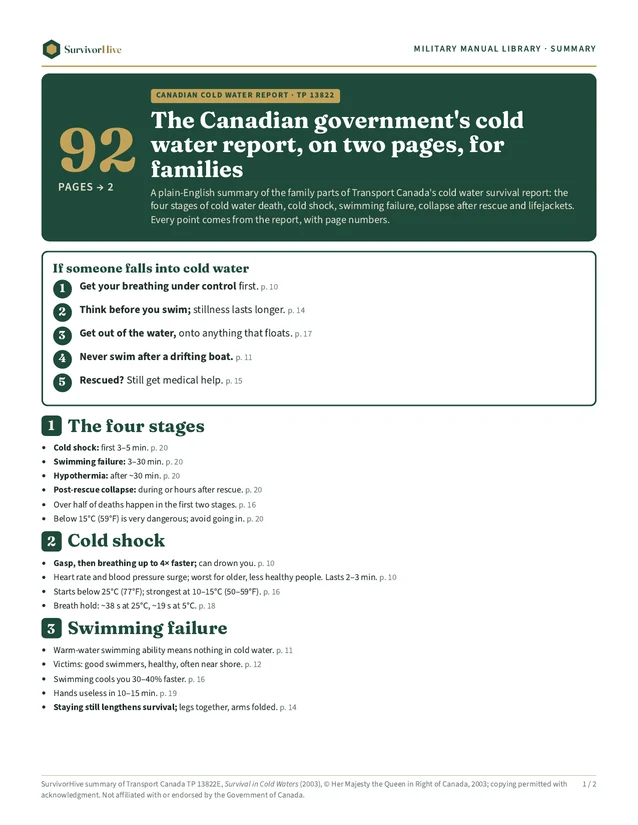
SurvivorHive Summary
2 printable pages: the four stages of cold water death, cold shock, swimming failure, collapse after rescue and lifejacket facts, with page numbers.
Get it free by email →If someone falls into cold water right now
- Get control of your breathing first. The gasp and fast breathing last two to three minutes, and that's when people inhale water. p. 10 p. 18
- Think before you swim. Even good swimmers fail in cold water, and swimming speeds cooling 30 to 40 percent. Staying still lengthens survival. p. 16 p. 14
- Hold still, legs together, arms folded. The report says a fetal position like this lengthens survival time. p. 14
- Get out of the water, not just afloat. Climb onto anything that floats. In one sinking, the two who got on top of a float were the two who didn't need hospital care. p. 17
- Pulled out? Still get help. Up to 20 percent of cold water deaths happen during or after rescue. p. 15
What this manual is, and what it isn't
This isn't a military manual. It's a Government of Canada report, written for Transport Canada's Marine Safety Directorate in six chapters: the problem, protecting people from the four stages of cold water immersion, immersion-suit design and testing, suit construction, how suits work with lifejackets, and who needs protection. p. 5 Each chapter ends with its own summary. p. 5
- We used Chapter 1 (the physiology of cold water) and the lifejacket chapter, the parts that apply to families.
- We skipped the immersion-suit engineering and the regulation proposals for ships and ferries.
- The Government of Canada Publications record lists it as archived (published 2003, catalogue T29-108/2003E-PDF), and the file was replaced with an updated-language version in August 2026 at the publisher's request. Publication record.
| The report says | What it means for you |
|---|---|
| Immersion | Being in the water, not just wet |
| Cold shock | The gasp and fast breathing in the first minutes |
| Swimming failure | Arms and hands too cold to keep swimming |
| PFD | Personal flotation device, a lifejacket |
Ch. 1The four ways cold water killsMost deaths happen long before hypothermia.
The report's central point: people pulled from cold water are usually said to have died of hypothermia, but many actually died in the first minutes, from cold shock or swimming failure. p. 16 p. 20
| Stage | When | What happens |
|---|---|---|
| 1. Cold shock | First 3 to 5 minutes | A gasp and uncontrolled fast breathing; heart rate and blood pressure surge. p. 10 p. 20 |
| 2. Swimming failure | 3 to 30 minutes | Arms and hands cool and stop working, even in strong swimmers. p. 11 p. 20 |
| 3. Hypothermia | After about 30 minutes | Core temperature falls until the person can't keep their face out of the waves. p. 14 p. 20 |
| 4. Post-rescue collapse | During rescue or hours after | People die while being lifted out, or after they seem safe. p. 15 p. 20 |
Ch. 1Cold shock: the first minutesThe gasp is what drowns people.
- On entry there's a large gasp, then breathing up to four times faster than normal. That alone can cause drowning. p. 10
- Heart rate and blood pressure surge; that can kill, especially older, less healthy people. The effects last for the first two to three minutes. p. 10
- Cold shock starts in water below 25°C (77°F) and is strongest between 10 and 15°C (50 to 59°F), which is why people die in water that doesn't feel dangerous. p. 16
- You can't hold your breath nearly as long: on average 38 seconds in 25°C (77°F) water, but 28, 24 and 19 seconds at 15, 10 and 5°C (59, 50 and 41°F). p. 18
- In choppy water, it's hard to time breaths with the splash. p. 18
- Sudden cold immersion makes the heart more prone to irregular beats, a real risk for anyone with a heart condition. p. 19
- The report's real cases include a 14-year-old who jumped into a 4°C (39°F) lake and a strong swimmer who drowned in waist-deep water on a New Year's plunge. p. 10
For a soldier
Because of cold shock, the report says operating close to shore, in a group, or with a rescue beacon is no reason to relax lifejacket rules: death from cold shock can come in 3 to 5 minutes. p. 2For your family
Spring is the trap: warm air, cold water. A lake can still be under 59°F well into early summer.Ch. 1Swimming failureGood swimmers drown in cold water.
- How well you swim in warm water says nothing about how you'll swim in cold water. p. 11
- Common threads in these deaths: good swimmers, cold water, healthy people, often shallow water, often within feet of the shore, with help nearby that didn't recognize the danger. p. 12
- Swimming speeds up body cooling by 30 to 40 percent. p. 16
- In one study, people wearing a flotation device in 14°C (57°F) water swam an average of only 889 meters (about half a mile) before their arms failed. p. 17
- Hands can become useless in the first 10 to 15 minutes, making it impossible to work a lifejacket inflator, hold a line or climb into a raft. Muscle strength drops in as little as 20 minutes in 12°C (54°F) water. p. 19
- Survival times are longer if people stay still rather than swim; holding a fetal position, legs together, arms at your sides or folded across the chest, also helps. p. 14
- Deciding to swim for shore or float and wait for rescue should not be taken lightly. p. 20
- One case in the report: a woman swam after her drifting boat in 10°C (50°F) water and drowned about 50 meters from shore. p. 11
Ch. 1Hypothermia in the waterWater pulls heat out fast.
- In cold water you cool about four times faster than in air at the same temperature. p. 12
- Moving, fast-flowing water and partial immersion all speed cooling. p. 12
- A lightly dressed person even in a lifejacket can drown from incapacitation after about one hour in 5°C (41°F) water, two hours at 10°C (50°F), or six hours or less at 15°C (59°F). p. 13
- After a 2 to 3°C drop in core temperature, people weaken, can no longer keep their backs t