
The UK military heat illness guide, in plain English for families
JSP 375 is the UK Ministry of Defence's health and safety handbook, and Chapter 41 is its heat illness policy. The chapter is mostly rules for commanders, but its annexes hold clear advice for anyone: who's most at risk, the warning signs, "strip, spray, fan" first aid, how much to drink, and what to do in a heatwave. We summarized the chapter and four of its annexes.
Quick facts
| Full title | JSP 375, Management of Health and Safety in Defence, Volume 1, Chapter 41: Heat illness prevention |
| Published by | UK Ministry of Defence, on GOV.UK |
| Date | Chapter v1.8 (May 2025); Annex A v1.6 (May 2025); Annexes B and F (June 2024); Annex H (August 2022) |
| Length | Chapter 25 pages; Annex A 26; Annex B 2; Annex F 3; Annex H 1 |
| Written for | UK Defence commanders, managers and individuals |
| Free to share? | Yes, under the Open Government Licence v3.0 |
| Best for families | Annex B, the individual's guide (PDF), and Annex H on extreme heat (PDF) |
| Safe to skip | The chapter's policy statements, WBGT monitor rules, reporting and training requirements |
The official UK Ministry of Defence manual
The full JSP 375 Vol 1 Ch 41, Chapter 41 itself, an unchanged copy of the GOV.UK file hosted by SurvivorHive. The annexes are linked below. Free, no email needed.
⬇ Download the official PDF (1 MB)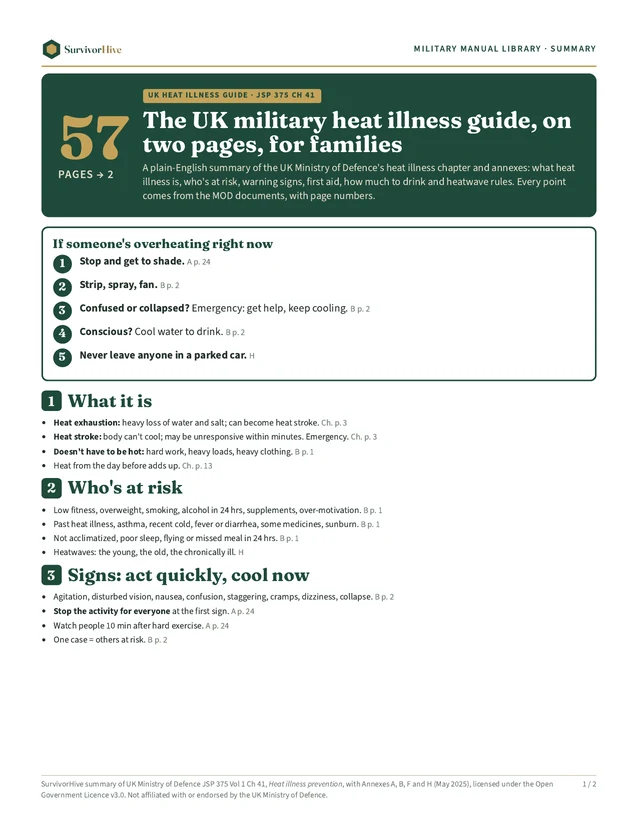
SurvivorHive Summary
2 printable pages: heat illness types, who's at risk, warning signs, strip-spray-fan first aid, how much to drink, and heatwave rules, with page numbers.
Get it free by email →If someone's overheating right now
- Stop and get to shade. Pause the activity for everyone at the first sign. Annex A, p. 24
- Strip, spray, fan. Heavy clothes off, water over light clothing, fan air over them. Annex B, p. 2
- Confused or collapsed? Heat stroke is an emergency. Get medical help and keep cooling. Ch. 41, p. 3 Annex B, p. 2
- Conscious? Give cool water to drink. Annex B, p. 2
- Child or pet in a parked car? Get them out now. Never leave anyone in a closed car. Annex H, p. 1
What this manual is, and what it isn't
Chapter 41 sets out the MOD's heat illness policy for commanders: planning, risk assessment with weather forecasts and work/rest tables, medical plans, monitoring, reporting and training. Ch. 41, p. 8 Its guidance is in eight annexes on GOV.UK. We used the four with advice anyone can follow:
- Annex A, Commander's Guide (26 pages): recognition, prevention and treatment. PDF
- Annex B, Individual's guide to heat illness (2 pages): risk factors, signs, first aid and prevention. PDF
- Annex F, Hydration guidance (3 pages). PDF
- Annex H, Basic guidance during extreme heat (1 page). PDF
- The other annexes (WBGT work/rest tables, monitor procurement, acclimatization for deployments and compliance examples) are on the GOV.UK page.
| The MOD says | What it means for you |
|---|---|
| WBGT | Wet bulb globe temperature: one number combining heat, humidity, wind and sun. Ch. 41, p. 3 |
| Strip, spray, fan | The cooling first aid everyone should be able to do. Ch. 41, p. 13 |
| Acclimatisation | Your body adjusting to heat; it lowers but doesn't remove the risk. Ch. 41, p. 13 |
Ch. 41What heat illness isIt doesn't have to be hot.
| Condition | What it is |
|---|---|
| Heat illness | A range of illnesses (heat cramps, heat exhaustion, heat stroke) caused by a rise in core body temperature. Ch. 41, p. 3 |
| Heat exhaustion | The body's response to heavy loss of water and salt, usually through sweating. Untreated, it can turn into heat stroke. Ch. 41, p. 3 |
| Heat stroke | The most serious kind. The body can't control its temperature, core temperature climbs fast, and the person can become unresponsive within minutes. A medical emergency. Ch. 41, p. 3 |
- It doesn't have to be hot. Heat illness can happen in cool weather from hard exercise, heavy loads or protective clothing. Annex B, p. 1
- People who live in a mild climate shouldn't be considered used to heatwaves. Ch. 41, p. 7 Ch. 41, p. 13
- Acclimatizing reduces the risk but doesn't remove it, and time in air conditioning slows it. Ch. 41, p. 13
- Heat from the day before adds up. Ch. 41, p. 13
Annex BWho's most at riskLifestyle, health and the day itself.
- Lifestyle: low fitness, being overweight, smoking, alcohol in the past 24 hours, sport supplements, drugs, and pushing too hard to pass a test. Annex B, p. 1
- Health: previous heat illness or collapse, asthma, a recent cold, fever or diarrhea, some medicines, recent vaccination, sunburn and dehydration. Annex B, p. 1
- Feeling unwell, especially with a respiratory infection, raises the risk. Ch. 41, p. 14
- The day: not acclimatized, long-term tiredness, poor sleep, flying in the last 24 hours, or a missed meal in the last 24 hours. Annex B, p. 1
- In extreme heat, the young, the old, people with long-term conditions and anyone outside for long periods are most at risk. Annex H, p. 1
Annex BRecognize it, then act fastAct quickly, cool now.
Signs vary from person to person: agitation, disturbed vision, nausea or vomiting, confusion, staggering or loss of coordination, cramps, dizziness, and collapse or fainting. Annex B, p. 2 Annex A, p. 24
- At the first sign, stop the activity for everyone, start treatment, get medical help and check whether others are struggling. Annex A, p. 24
- Normal tiredness and sore muscles don't need reporting; unusual discomfort or distress does. Annex B, p. 2
- Watch people for at least 10 minutes after hard exercise. Annex A, p. 24
- One case means others are at risk too. Annex B, p. 2
Annex BFirst aid: strip, spray, fanCool them where they fall.
- Move them into the shade and start cooling them. Annex B, p. 2
- Strip off heavy clothing and boots; raise their feet if they're conscious. Annex B, p. 2
- Spray or drizzle water over their remaining light clothing. Annex B, p. 2
- Fan air over them. Annex B, p. 2
- If conscious, give them cool water to drink. If unconscious, check airway, breathing and circulation. Annex B, p. 2
- Get medical help. Moderate and severe cases need professional care. Annex B, p. 2
- Everyone should be able to strip, spray and fan right away, without waiting for medics. Ch. 41, p. 13
- If they recover within 30 minutes, keep watching them for 4 hours and avoid heat-risk activity for at least 48 hours. Annex B, p. 2</