
The Army arctic manual, in plain English for families
ATP 3-90.96 (the Marine Corps calls it MCTP 12-10E) is the military's newest cold-weather handbook. Most of it covers military operations in the Arctic. But chapter 1 and appendices C and D are a sharp guide to cold itself: windchill and frostbite times, hypothermia, carbon monoxide, layering, and whether ice will hold you. That's what we summarized.
Quick facts
| Full title | ATP 3-90.96 / MCTP 12-10E, Arctic and Extreme Cold Weather Operations |
| Published by | Headquarters, Department of the Army, and Headquarters, US Marine Corps |
| Date | 24 February 2025, incorporating Change 2 (March 2026) · listed as Active |
| Length | 292 PDF pages: 10 chapters and 7 appendices |
| Written for | Army and Marine Corps leaders planning cold-weather operations |
| Free to share? | Yes. Approved for public release; distribution is unlimited cover |
| Replaced | MCRP 12-10A.4, Cold Regions Operations, January 2011 cover |
| Best for families | The environment and its hazards (ch. 1), ice safety (app. C) and cold injuries (app. D) |
| Safe to skip | Chapters 2 to 10 and appendices A, B, E, F and G: strategy, operations, vehicles and planning |
The official Army and Marine Corps manual
The full ATP 3-90.96 / MCTP 12-10E, an unchanged copy of the Army Publishing Directorate file, hosted by SurvivorHive. Free, no email needed.
⬇ Download the official PDF (16 MB)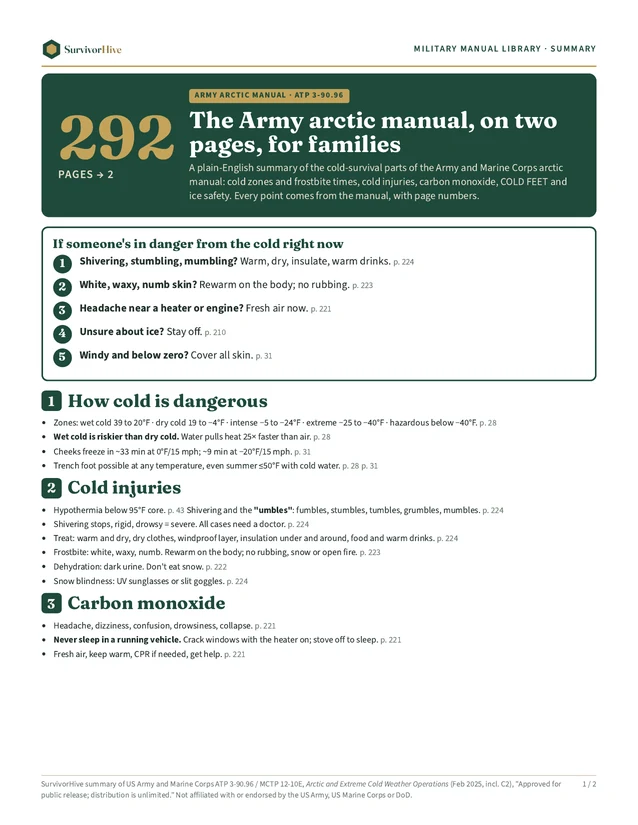
SurvivorHive Summary
2 printable pages: cold zones and frostbite times, hypothermia and frostbite, carbon monoxide, COLD FEET, and safe ice thickness, with page numbers.
Get it free by email →If someone's in danger from the cold right now
- Shivering, stumbling, mumbling? Get them warm and dry, add insulation, give warm drinks. Shivering that stops is severe. p. 224
- White, waxy, numb skin? Rewarm against the body. Don't rub it or hold it to a fire. p. 223
- Headache or drowsy near a heater or engine? Get to fresh air now. Never sleep in a running car. p. 221
- Not sure about the ice? Stay off. Even perfect clear ice needs 4 inches for regular foot traffic. p. 210
- Windy and below zero? Cover all skin. Cheeks can freeze in minutes. p. 31
What this manual is, and what it isn't
ATP 3-90.96 / MCTP 12-10E covers the Arctic environment, operational planning, command, maneuver, intelligence, fires, sustainment, protection and training, with appendices on mobility, ice, cold injuries and planning factors. contents For deeper cold-weather first aid, it points readers to TC 21-3. p. 221
| The manual calls it | What it means for you |
|---|---|
| CWI | Cold weather injury, like hypothermia, frostbite or trench foot. p. 43 |
| The umbles | Fumbles, stumbles, tumbles, grumbles and mumbles: early hypothermia signs. p. 224 |
| White ice | Cloudy, bubbly ice with half the strength of clear ice. p. 210 |
| Whiteout | Blowing snow or fog that erases the horizon and depth. p. 32 |
Ch. 1How cold is dangerous?Five cold zones, windchill and frostbite times.
| Zone | Temperature | What it means |
|---|---|---|
| 1 · Wet cold | 39 to 20°F | Riskier than dry cold. Slush, rain and wet clothes; water pulls heat away 25 times faster than air. |
| 2 · Dry cold | 19 to −4°F | Easier to handle than wet cold, but windchill matters. |
| 3 · Intense cold | −5 to −24°F | Simple tasks get slower. |
| 4 · Extreme cold | −25 to −40°F | Serious risk for people and gear. |
| 5 · Hazardous cold | Below −40°F | Much higher injury risk. |
- Windchill multiplies the cold. Moving vehicles and snowmobiles make their own wind. p. 30 p. 31
- At 0°F with a 15 mph wind, exposed cheeks can freeze in about 33 minutes; at −20°F with the same wind, in about 9 minutes. Wet skin and fingers freeze faster. p. 31
- Frostbite doesn't happen above freezing, but trench foot can happen at any temperature on the chart. p. 31
- Even in summer, cold water and temperatures at or below 50°F can cause trench foot. p. 28
- It gets 3 to 5°F colder for every 1,000 feet you climb, but on calm, clear winter nights cold air pools in valleys. p. 28 p. 29
- Freezing rain makes a nearly invisible, very slippery glaze. p. 35
App. DCold injuries: spot them earlyHypothermia, frostbite, dehydration and more.
- Hypothermia starts when core temperature falls below 95°F. p. 43 Watch for the "umbles": fumbles, stumbles, tumbles, grumbles and mumbles, plus shivering, confusion and pale, cool skin. p. 224
- When shivering stops, muscles stiffen and the person drifts toward unconsciousness: that's severe hypothermia. Every case needs a doctor. p. 224
- Treatment: get them from cold and wet to warm and dry, swap damp clothes for dry ones, add a windproof layer and insulation under and around them, and give food and warm drinks. p. 224
- Frostbite: skin turns white, waxy and pale (or red and pale in darker skin) and goes numb. Rewarm hands under clothing against the body, and feet against a buddy's belly. Don't rub with snow, massage it, or hold it to an open fire. p. 223
- Dehydration happens fast in cold, dry air even when you don't feel sweaty. Dark yellow urine is a warning. Don't eat snow when water is short; it chills you. p. 43 p. 222
- Snow blindness can hit in a couple of hours of bright snow, especially March to May. Wear UV-blocking sunglasses; if you have none, cut slits in cardboard or bark. p. 34 p. 224
- You can overheat in the cold. Overdressing for hard work can cause heat exhaustion. p. 44
App. DCarbon monoxide: the silent winter killerStoves, heaters and idling engines.
Carbon monoxide poisoning is on the manual's list of common cold-weather injuries. p. 221
- Signs: headache, dizziness, confusion, yawning, tiredness, nausea, ringing ears, drowsiness and sudden collapse. Someone found unconscious in a closed shelter should be suspected of CO poisoning. p. 221
- Never sleep in a running vehicle. Crack the windows when the heater is on, and don't warm up from engine exhaust. p. 221
- Make sure stoves and lanterns work properly, and shut the stove off when you sleep. p. 221
- Treatment: get them into fresh air, keep them still and warm, start CPR if needed, and get help right away. p. 221
App. DDress for it: COLD FEETThe military's eight rules for staying warm.
| Letter | Rule |
|---|---|
| C | Keep clothing clean. Dirty clothes insulate less. |
| O | Avoid overheating. Sweat soaks clothes and chills you. |
| L | Wear clothing loose and in layers. Loosen or remove layers when working hard. |
| D | Keep clothing dry. Socks and underclothes can dry in your sleeping bag with you. |
| F | Fit clothes properly and seal ankles, waist, neck, head and wrists. |
| E | Exercise your face, fingers and toes. |
| E | Eat and drink plenty. No alcohol; it makes you lose heat. |
| T | Tight boots are terrible. They cut off blood flow. Keep boots waterproofed. |