
The Army jungle manual, in plain English for families
ATP 3-90.98 (the Marine Corps calls it MCTP 12-10C) is the military's jungle handbook. Most of it covers military operations, but its first chapter and appendix B are a practical guide to what hot, wet places do to people: heat and humidity, unsafe water, mosquitoes and leeches, trench foot, cold nights and crossing streams. That's what we summarized.
Quick facts
| Full title | ATP 3-90.98 / MCTP 12-10C, Jungle Operations |
| Published by | Headquarters, Department of the Army, and Headquarters, US Marine Corps |
| Date | 24 September 2020 · listed as Active |
| Length | 208 PDF pages: 7 chapters and 5 appendices |
| Written for | Army and Marine Corps leaders and troops |
| Free to share? | Yes. Approved for public release; distribution is unlimited contents page |
| Replaced | FM 90-5 and MCTP 12-10C, dated 16 August 1982 contents page |
| Best for families | The jungle environment and its effects on people (ch. 1) and crossing streams (app. B) |
| Safe to skip | Chapters 2 to 7 and appendices A, C and D: military planning, operations, navigation and loads |
The official Army and Marine Corps manual
The full ATP 3-90.98 / MCTP 12-10C, an unchanged copy of the Army Publishing Directorate file, hosted by SurvivorHive. Free, no email needed.
⬇ Download the official PDF (8 MB)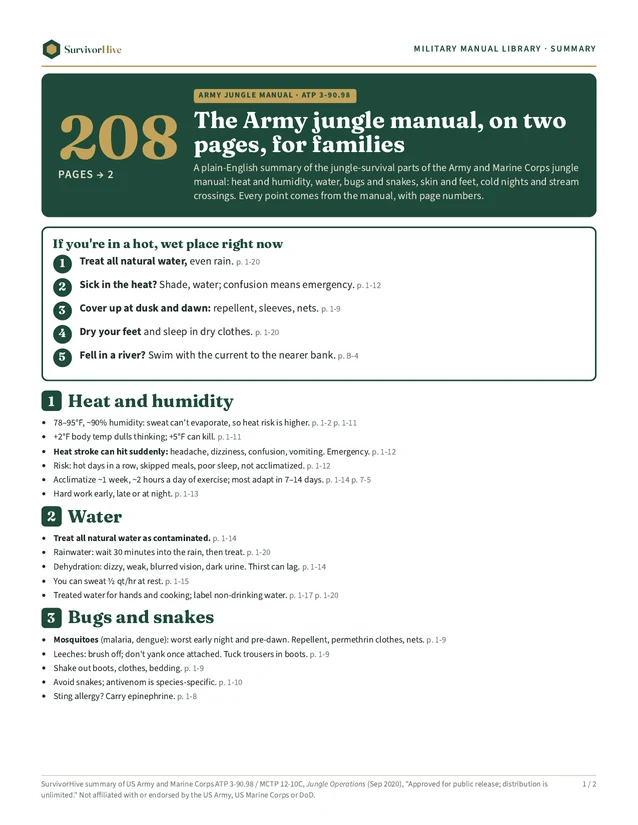
SurvivorHive Summary
2 printable pages: heat and humidity, safe water, bugs and snakes, trench foot and skin, cold nights and stream crossings, with page numbers.
Get it free by email →If you're in a hot, wet place right now
- Treat all natural water. Even clear streams and rain. Use treated water for drinking, cooking and hands. p. 1-14 p. 1-20
- Feeling sick in the heat? Rest in shade and drink. Confusion or collapse is heat stroke: call for emergency help. p. 1-12
- Cover up at dusk and dawn. Repellent, long sleeves and a net when mosquitoes are worst. p. 1-9
- Dry your feet. Dry socks as soon as you can, and boots off to sleep. p. 1-20
- Fell into a river? Swim with the current toward the nearer bank. p. B-4
What this manual is, and what it isn't
ATP 3-90.98 / MCTP 12-10C covers the jungle environment, the foundations of jungle operations, offense, defense, stability operations and training, plus appendices on navigation, crossing obstacles and loads. contents Chapter 1 describes what heat, humidity, water and wildlife do to people and how to protect against them; appendix B covers ropes and getting across streams. p. 1-10 p. B-1
| The manual calls it | What it means for you |
|---|---|
| Immersion syndrome | Trench foot: foot damage from staying wet too long. p. 1-20 |
| Potable water | Water that's safe to drink. p. 1-17 |
| Acclimatization | Your body getting used to heat over about one to two weeks. p. 1-14 |
| Fording | Crossing water while your feet stay on the bottom. p. B-4 |
Ch. 1Heat plus humidityWhy the jungle overheats people, and how to adapt.
Jungles average 78 to over 95°F with very high humidity. p. 1-2 Humidity is what makes it dangerous: sweat can't evaporate, so the body can't cool itself, and the risk of heat injury is higher than in drier places. p. 1-5 p. 1-11
- A rise of just 2°F in body temperature dulls thinking and performance; 5°F can mean serious illness or death. p. 1-11
- Heat stroke is the most dangerous heat injury and can come on suddenly: headache, dizziness, confusion, weakness, nausea and vomiting, and sweating may or may not stop. It's a medical emergency. p. 1-12
- Risk goes up with several hot days in a row, skipped meals, poor sleep, poor fitness, not being acclimatized, and hard work day after day. p. 1-12
- Eat. Heat kills appetite, and burning more calories than you eat raises the risk; have the bigger meal when it's cooler. p. 1-12
- Work early in the morning, late in the evening or at night when you can. p. 1-13
- Acclimatizing takes about a week of daily heat exposure, about two hours a day, which can be split into two one-hour sessions of exercise that gets your heart rate up. Most people adapt within 7 to 14 days. p. 1-14 p. 7-5
- Heat rash, from tight clothes, heavy sweating and poor hygiene, blocks sweat and raises heat risk. p. 1-11
For a soldier
Troops follow the same work/rest and water table used for desert heat. p. 1-13For your family
On a tropical vacation, the first few days are the riskiest. Ease into hikes and keep the hardest activity for mornings.Ch. 1Water: plenty around, none safeTreat every natural source as contaminated.
Water is easy to find in the jungle, but the manual says to consider water from natural sources as contaminated. Drinking water is still the most important need. p. 1-14
- Dehydration signs: dizziness, weakness or fatigue, blurred vision, thirst and dark urine. Thirst doesn't always show up, especially when you're excited. p. 1-14
- Losing about 2 quarts of body fluid (about 2.5 to 3 percent of body weight) already impairs you. p. 1-14
- At rest in jungle heat you can sweat away half a quart an hour. p. 1-15
- Carry as much water as you can when you're away from a safe source, and rest in the shade when possible. p. 1-16
- Collecting rain? Wait until it has rained for at least 30 minutes, so the first dirty runoff from the canopy is washed away, and still treat it before drinking. p. 1-20
- Use treated water for washing hands and cooking. p. 1-20
- Water is hardest to drink above 75 to 80°F and easiest at 50 to 60°F. Keep containers in the shade. p. 1-16 p. 1-17
- Never confuse non-drinking water with drinking water; label it. p. 1-17
Ch. 1Mosquitoes, leeches, snakes and stingsThe jungle's real dangers are mostly small.
- Mosquitoes are the most dangerous jungle insect. They spread malaria, dengue, chikungunya and yellow fever, and are worst early at night and just before dawn. p. 1-9
- Protection: prescribed antimalaria medicine where needed, insect repellent, permethrin-treated clothing that covers as much skin as possible, and nets or screens. p. 1-9
- Leeches: brush them off before they bite. Once attached, don't pull them off forcibly; part can stay in the skin. Tuck trousers into boots. Bites can get infected. p. 1-9
- Centipedes, spiders and scorpions like dark places. Shake out bedding, clothes and boots before using them. Spider bites can need medical care. p. 1-9 p. 1-20
- Wasps and bees rarely attack unless the nest is disturbed. If it is, leave the area. People with sting allergies should carry epinephrine. p. 1-8 p. 1-9
- Snakes: stay alert and avoid disturbing them, especially when clearing ground. Antivenom is specific to the species; there's no universal one. p. 1-9 p. 1-10
- Plants with milky sap or red beans or berries are often poisonous. Keep sleeves down and wear gloves. p. 1-8
- Large animals usually won't attack unless cornered or wounded. Water buffalo and elephants may look tame but aren't. p. 1-10