
The Marine Corps water survival manual, in plain English for families
MCRP 7-20B.5 is how the Marine Corps teaches people to survive in the water: rescuing someone without becoming a second victim, floating without a life jacket, staying alive in cold water, and getting out of rip currents and fast rivers. If your family swims, boats or lives near water, these are the parts worth knowing.
Quick facts
| Full title | MCRP 7-20B.5, Marine Corps Water Survival |
| Published by | Headquarters, US Marine Corps |
| Date | 2 May 2016; Change 1, 4 April 2018; renumbered from MCRP 8-10B.6 in October 2021 · listed as Current erratum |
| Length | 122 PDF pages: 5 chapters |
| Written for | Marines in the Marine Corps Water Survival Program |
| Free to share? | Yes. Distribution Statement A: approved for public release; distribution is unlimited cover |
| Best for families | Rescues (ch. 2), floating and cold water (ch. 1), hypothermia and sea hazards (ch. 3), surf and rip currents (ch. 4), river crossings (ch. 5) |
| Safe to skip | Abandoning ship in combat gear, swimming with packs, and military equipment |
The official Marine Corps manual
The full MCRP 7-20B.5, an unchanged copy of the Marine Corps file, hosted by SurvivorHive. Free, no email needed.
⬇ Download the official PDF (38 MB)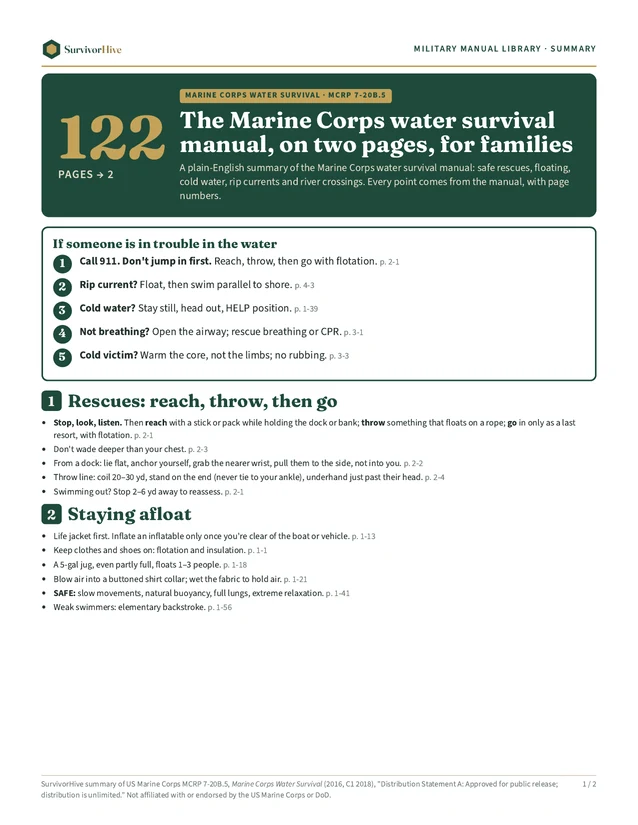
SurvivorHive Summary
2 printable pages: reach-throw-go rescues, floating, cold water, rip currents and river crossings, with page numbers.
Get it free by email →If someone is in trouble in the water right now
- Call 911 and don't jump in first. Reach with something, or throw something that floats. Go in only as a last resort, with flotation. p. 2-1
- Caught in a rip current? Don't fight it. Float, then swim parallel to the shore. p. 4-3
- In cold water? Don't swim to keep warm. Keep your head out, stay still, and hug your knees in a life jacket. p. 1-39
- Pulled someone out cold? Dry clothes, warm the chest, neck and groin, no rubbing, and get medical help. p. 3-3
- Not breathing? Open the airway and start rescue breathing or CPR, and don't give up on a cold-water victim. p. 3-1 p. 3-2
What this manual is, and what it isn't
MCRP 7-20B.5 covers survival in open water, water rescues, treating casualties and avoiding dangerous marine life, crossing water obstacles, and fording rivers, plus an appendix on knots. contents It was first published as MCRP 8-10B.6 and renumbered in 2021 with no change to the content. erratum
| The Marine Corps calls it | What it means for you |
|---|---|
| Drownproofing | Floating and breathing with very little effort, life jacket or not. p. 1-41 |
| HELP position | Heat escape lessening posture: curling up in a life jacket to hold in heat. p. 1-39 |
| Survival stroke | A slow, energy-saving way to swim, like the elementary backstroke. p. 1-46 |
| Ford | A spot shallow enough to cross a river without floating. p. 5-1 |
Ch. 2Rescuing someone without drowning yourselfReach, throw, and go only as a last resort.
A drowning person can panic and grab a rescuer with surprising strength, and drown them both. That's why the manual says a rescue should be done from a distance whenever possible: reaching, wading or throwing come first, and swimming out is the last resort. p. 2-1
The manual's "Cardinal Rule"
- Stop what you're doing. Look around. Listen for calls for help. p. 2-1
- Reach from the edge with something they can grab, like a stick or a pack, while you keep hold of the dock, bank or a solid support. Talk to them the whole time. p. 2-1 p. 2-2
- Throw something that floats, ideally tied to a rope so you can pull them in or throw again. p. 2-1
- Go into the water only as a last resort, and only with a flotation device. You, the rescuer, are number one. p. 2-1
- Don't wade in deeper than your chest. p. 2-3
- Reaching from a dock: lie flat, legs spread, one hand pressed on the deck behind you, and grab the wrist closest to you. Pull them to the side, never into you. p. 2-2
- An improvised throw device can be any weighted item that floats, like a canteen a quarter full of water, tied to the end of a rope. Pull steadily, but not so hard you break their grip. p. 2-3
- Coil 20 to 30 yards of rope, stand on the free end (never tie it to your ankle), and throw underhand just past their head so the rope lands across their arms. p. 2-3 p. 2-4
Ch. 1Staying afloatLife jackets first, then whatever floats, then your own body.
The best flotation is anything that keeps you out of the water or limits how much of you is in it. A life preserver is best of all, because you can keep your clothes on for warmth and sun protection. p. 1-13
- Don't inflate an inflatable life jacket until you're clear of the boat, aircraft or vehicle. A torn one won't inflate, and an inflated one can trap you and the people behind you. p. 1-13
- Store inflatable life jackets cool and dry, and keep the gas cartridges away from heat. p. 1-13
- Keep your clothes and shoes on if you have to go into the water. They may be your only flotation if your life jacket fails, and they insulate you from cold water. p. 1-1
- A 5-gallon plastic water jug, even partly full, can hold up one to three people. Hug it and rest your chin on top. p. 1-18
- A buttoned shirt or jacket can be blown full of air through the collar as a temporary float. Splash water on it now and then; dry fabric leaks air. p. 1-21 p. 1-25
- In warm water, trousers can be tied off and inflated as a float. In cold water, the heat and energy lost getting them off outweigh the benefit. p. 1-25
Floating without a life jacket
Most people float. You can test it in chest-deep water: take a full breath, bend forward slowly, relax and wait. p. 1-41 Whatever your buoyancy, the manual's drownproofing methods can keep you at the surface for a long time. Remember SAFE: Slow, easy movements; Apply your natural buoyancy; Full lungs with each breath; Extreme relaxation, because tense muscles don't float as well. p. 1-41
For weak swimmers or nonswimmers, the manual recommends the elementary backstroke. The front crawl is fast but exhausting, and not a preferred survival stroke. p. 1-56 p. 1-46
Ch. 1 and 3Cold water: don't swim to stay warmThe HELP position, huddling, and treating hypothermia.
Water pulls heat from the body about 25 times faster than air of the same temperature, and wet clothing loses much of its insulation. Keep your head out of the water. Other areas of high heat loss are the neck, the armpits and sides, and the groin. p. 1-38
In cold water, don't swim to stay warm. Swimming makes heat that's lost straight into the water. Staying still conserves body heat about three times longer than swimming. Swim only if you have flotation and you can see the shore. p. 1-39
- HELP (heat escape lessening posture), if you're wearing a life jacket: chin tucked, knees drawn up, arms crossed over the chest with hands in the armpits. Cover your head if you can. p. 1-39
- Huddle, for three or more people in life jackets: wedge tightly together and lock arms in a circle. Put anyone who is very cold in the middle. A group is also easier for rescuers to spot, and it reduces panic. p. 1-40
- Children and small people cool faster than adults. p. 3-2