
The Army Field Sanitation Manual, in plain English for families
ATP 4-25.12 is the handbook for the soldiers whose job is keeping a whole unit from getting sick in the field: treating water in bulk, keeping food safe, handling trash and toilets, and controlling pests. If your family ever ends up looking after neighbors, a church shelter or a crowded house after a disaster, this is the same job.
Quick facts
| Full title | ATP 4-25.12, Unit Field Sanitation Teams |
| Published by | Headquarters, Department of the Army |
| Date | 30 April 2014, incorporating Change 2 (8 August 2025) · listed as Active |
| Length | 174 PDF pages: 11 chapters |
| Written for | Unit field sanitation teams and leaders |
| Free to share? | Yes. Approved for public release; distribution is unlimited cover |
| Replaced | FM 4-25.12 (FM 21-10-1), dated 25 January 2002 p. i |
| Best for families | Water (ch. 3), food (ch. 4), trash and toilets (ch. 5), pests and rabies (ch. 6), carbon monoxide (ch. 8) |
| Safe to skip | Burn pits, Force Provider systems, industrial chemicals and unit reporting |
The official Army manual
The full ATP 4-25.12, straight from the Army Publishing Directorate. Free, no email needed.
⬇ Download the official PDF (5 MB)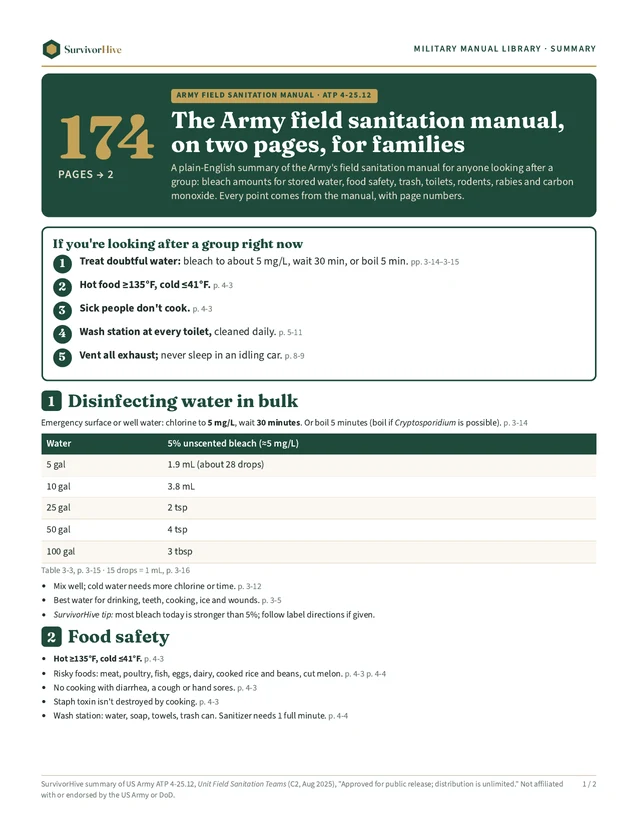
SurvivorHive Summary
2 printable pages: bleach amounts, food temperatures, trash, toilets, rodents, rabies and carbon monoxide, with page numbers.
Get it free by email →If you're looking after a group right now
- Treat doubtful water. Bleach to about 5 mg/L and wait 30 minutes, or boil for five minutes. p. 3-14 p. 3-15
- Hot food hot, cold food cold. 135°F or above, 41°F or below. p. 4-3
- Sick people don't cook. Anyone with diarrhea, a cough or hand sores stays out of the kitchen. p. 4-3
- Wash station at every toilet. Water and soap right outside, cleaned daily. p. 5-11
- Vent all exhaust. Never sleep in an idling car; watch for headache and confusion. p. 8-9
What this manual is, and what it isn't
ATP 4-25.12 covers the field sanitation team's role, health threats in the field, unit water supply, food service sanitation, waste, pests, heat and cold injury, toxic industrial materials, noise and sickle cell trait. contents It's a companion to TC 4-02.3, which covers the same ground for the individual soldier.
| The Army calls it | What it means for you |
|---|---|
| Potable water | Water safe to drink and cook with. p. 3-5 |
| Chlorine residual | Chlorine left in the water after treatment, still protecting it. p. 3-12 |
| Potentially hazardous foods | Foods that spoil dangerously without temperature control. p. 4-3 |
| Cat-hole latrine | A small dug toilet for people on the move. p. 5-14 |
Ch. 3Disinfecting water in bulkFor rain barrels, tanks and big containers.
Use your best water for drinking, brushing teeth, cooking, making ice and treating wounds. Water that isn't drinking quality can still be used for things like firefighting and washing vehicles. p. 3-5
In an emergency, when natural surface water or well water is the only source, the manual's chlorine target is 5 mg/L (5 parts per million) after a 30-minute contact time. The alternative is boiling for five minutes, and boiling is the recommended method if Cryptosporidium may be present, because chlorine works poorly against it. p. 3-14
| Water | 5% household bleach for about 5 mg/L |
|---|---|
| 5 gallons | 1.9 mL (about 28 drops) |
| 10 gallons | 3.8 mL |
| 25 gallons | 2 teaspoons |
| 50 gallons | 4 teaspoons |
| 100 gallons | 3 tablespoons |
Table 3-3, p. 3-15. Use unscented bleach. 15 drops = 1 mL. p. 3-16
- Mix thoroughly so the chlorine reaches all the water. p. 3-12
- Cold water needs more chlorine or more contact time. p. 3-12
- The amount left after treating depends on how dirty the water is; the dirtier it is, the less chlorine remains. p. 3-15
Ch. 4Food safety for a crowdWhen you're feeding family, neighbors or a shelter.
The five things that most often cause food poisoning outbreaks are food held at the wrong temperature, food not cooked enough, dirty equipment, food from unsafe sources, and poor personal hygiene. p. 4-3
- Keep hot food at 135°F or above and cold food at 41°F or below. p. 4-3
- High-risk foods include ground meat, poultry, fish, eggs, dairy, cooked rice, beans and vegetables, and cut melons. p. 4-3 p. 4-4
- Anyone with diarrhea, a cough or sores on their hands shouldn't prepare food. p. 4-3
- Staph toxins in hand-made foods like sandwiches, sliced meats and pastries aren't destroyed by cooking and can cause illness in as little as 30 minutes. p. 4-3
- Set up handwashing with water, soap, paper towels and a trash can. Hand sanitizer needs a full minute of contact and doesn't replace soap. p. 4-4
For a soldier
Soldiers have a trained field sanitation team that inspects food, water and latrines. p. 4-3For your family
In a family or neighborhood, pick one calm, organized person to own this job. It's the same idea.Ch. 5Trash and toiletsWhen pickup or plumbing stops.
Trash
- Bag and tie all trash, and keep it in containers with lids. p. 5-2
- Keep the collection spot at least 300 feet downslope and downwind from where people sleep, and at least 100 feet from food areas, wells and water. p. 5-2
- Remove trash at least twice a week. p. 5-2
Toilets
- Cat hole when on the move: about 1 foot deep and 1 foot across. Fill it in completely and pack the dirt down. p. 5-14
- Pail latrine where you can't dig: line pails with plastic, clean them at least daily, and put about an inch of disinfectant in the bottom. p. 5-17
- Put a handwashing setup right outside every toilet, and clean toilets daily so they don't draw flies. p. 5-11
- Make sure the toilet can be reached safely day and night. p. 5-12
Ch. 6Rodents and stray animalsKeeping disease carriers away.
- Sanitation is the most important rodent control. Keep garbage in rodent-proof containers and don't let it pile up. p. 6-12
- Store food off the floor, 12 to 18 inches up on pallets or shelves. p. 6-12
- Cleaning and housekeeping prevent infestations better than trapping and poisoning remove them. p. 6-12
- Snap traps and glue boards work best for small numbers of rodents; check them regularly. p. 6-13
Rabies
Don't approach, feed or handle wild or stray animals. If you're bitten, or saliva gets on broken skin or in your eyes or mouth, wash right away with soap and water and get medical care immediately. Rabies is preventable with prompt care, but almost always fatal once symptoms start. p. 6-14
Ch. 8Carbon monoxideThe silent danger during outages.
Carbon monoxide is odorless and colorless and can cause sudden illness and death. It builds up when exhaust from generators, heaters and vehicles isn't vented. Watch for headache, confusion, dizziness and excessive yawning. p. 8-9