
The Army Visual Signals Manual, in plain English for families
TC 3-21.60 is the Army's book of visual signals: hand signals for patrols and vehicles, helicopter guidance and pyrotechnics. Most of it is for soldiers and you can skip it. But chapter 3 has something every family should know: how to signal a rescue aircraft without a radio, with your body, with symbols on the ground and with a mirror.
Quick facts
| Full title | TC 3-21.60, Visual Signals |
| Published by | Headquarters, Department of the Army |
| Date | 17 March 2017 · listed as Active, the current edition |
| Length | 96 PDF pages: 4 chapters |
| Written for | Soldiers and leaders who need to signal without radios |
| Free to share? | Yes. Approved for public release; distribution is unlimited cover |
| Replaced | FM 21-60, dated 30 September 1987 cover |
| Best for families | Ground-to-air emergency signals, codes and mirrors (ch. 3), and a few hand signals (ch. 1) |
| Safe to skip | Patrol formations, vehicle and convoy signals, and pyrotechnics |
The official Army manual
The full TC 3-21.60, straight from the Army Publishing Directorate. Free, no email needed.
⬇ Download the official PDF (2 MB)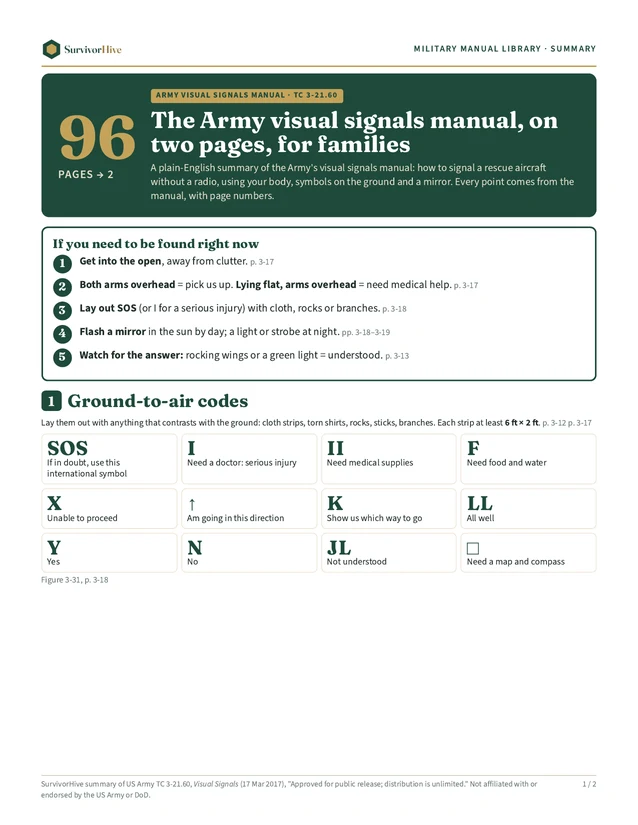
SurvivorHive Summary
2 printable pages: ground-to-air codes, body signals, mirrors and hand signals, with page numbers.
Get it free by email →If you need to be found right now
- Get into the open. Stand somewhere the background isn't cluttered from the air. p. 3-17
- Use your body. Both arms overhead means "pick us up"; lying flat with arms stretched overhead means "need medical help." Move slowly and repeat. p. 3-17
- Lay out a big symbol. SOS if you're unsure, or I for a serious injury, using cloth, rocks or branches that contrast with the ground. p. 3-17 p. 3-18
- Flash a mirror in the sun. By day, a mirror can catch a pilot's eye. At night, use a strobe or light. p. 3-18 p. 3-19
- Watch for the answer. Rocking wings or a green light means understood; a 360° turn to the right or a red light means not understood. p. 3-13
What this manual is, and what it isn't
TC 3-21.60 sets out the standard visual signals soldiers use when radios can't be used, from hand signals to signals for aircraft. p. 3-1 It has four chapters: dismounted hand signals, vehicle signals, aircraft signals, and pyrotechnics. contents Only part of chapter 3 and a few hand signals matter for most families.
| The Army calls it | What it means for you |
|---|---|
| Ground-to-air emergency signals | Body positions a pilot can read. p. 3-17 |
| Emergency codes | Symbols laid out on the ground. p. 3-17 |
| Panels | Strips of contrasting material used to build symbols. p. 3-12 |
| Strobe / distress marker | A flashing light for night. p. 3-19 |
Ch. 3Signals you make with your bodyHow to talk to a pilot or helicopter crew with no radio.
When you can't use a radio, you can send messages to an aircraft with your body. Stand in an open area where the background (seen from the air) isn't cluttered, make each signal slowly, and repeat it until it's understood. p. 3-17
| Message | The manual's signal (figure 3-30) |
|---|---|
| Need medical help | Lie flat on the ground with arms stretched above the head |
| Pick us up | Both arms raised straight overhead |
| All OK, don't wait | One arm raised straight up |
| Land here | Crouch with both arms pointing forward, toward where to land |
| Don't land here | Both arms overhead, waving side to side |
| Yes / No | An arm waved up and down for yes; side to side for no |
Ch. 3Ground-to-air codesBig symbols you lay out on the ground.
These emergency codes are understood by allied pilots worldwide. Make them from anything that stands out against the ground: strips of cloth or torn shirts, rocks, sticks or branches. Once laid out, they stay up without you. p. 3-16 p. 3-17
Figure 3-31, p. 3-18
Make them big enough to read
Ch. 3How a pilot answers youKnowing you've been seen.
A pilot shows a signal was understood by rocking the wings side to side or flashing a green light. A pilot shows it was not understood by making a full 360° turn to the right or flashing a red light. p. 3-13
Ch. 3Signal mirrors and lightsGetting a pilot's attention, day or night.
- By day, a mirror can catch a pilot's attention. It needs good visibility and sun with little or no cloud cover. p. 3-18
- The Army's signal mirror has instructions printed on the back; the figure shows sighting the aircraft through the mirror and moving the reflected light onto it. p. 3-18 p. 3-19
- At night, a strobe can mark your position. p. 3-19
Ch. 1Hand signals for a groupSimple, silent signals for a noisy or windy place.
A few of the Army's basic hand signals work well for a family on a hike, in a crowd or in high wind:
| Signal | How to do it |
|---|---|
| Halt | Raise a hand to head level, fingers extended and together. p. 1-12 |
| Take a knee | After the halt signal, lower the hand to waist level, palm down. p. 1-12 |
| Come here / follow me | Point at the person, then hold the arm out in front, palm up, and motion toward your body. p. 1-2 |
| Rally / gather here | Raise the arm overhead, palm forward, and wave in large horizontal circles, then point to the meeting spot. p. 1-2 |
Signals drawn with a double arrow are repeated until they're acknowledged. p. 1-1
Ch. 3Around a helicopterWhere to stand and what to expect.
The manual has soldiers guiding a helicopter stand slightly to its right, in full view of the pilot, and no closer than 40 meters (about 130 feet). p. 3-1