
The Army Heat Illness Manual, in plain English for families
TB MED 507 is the Army's medical guide to working safely in the heat and treating heat casualties. It's written for military doctors, medics and leaders, so much of it is technical. Underneath is advice every family can use in a heat wave or on a hot summer day: how to adapt to heat, how much water is enough (and how much is too much), and how to tell heat exhaustion from heat stroke and what to do in the first minutes.
Quick facts
| Full title | TB MED 507, Heat Stress Control and Heat Casualty Management |
| Published by | Headquarters, Department of the Army |
| Date | 12 April 2022, with language updated in 2025 · listed as Active cover |
| Length | 81 PDF pages: 5 chapters plus appendixes |
| Written for | Military medical staff, leaders and trainers |
| Free to share? | Yes. Approved for public release; distribution is unlimited |
| Replaced | TB MED 507 dated 7 March 2003 cover |
| Best for families | Adapting to heat (ch. 2), water (ch. 3), heat illness (ch. 4), first actions (ch. 5) |
| Safe to skip | Lab values, hospital treatment, aviation and military reporting |
The official Army manual
The full TB MED 507, straight from the Army Publishing Directorate. Free, no email needed.
⬇ Download the official PDF (3 MB)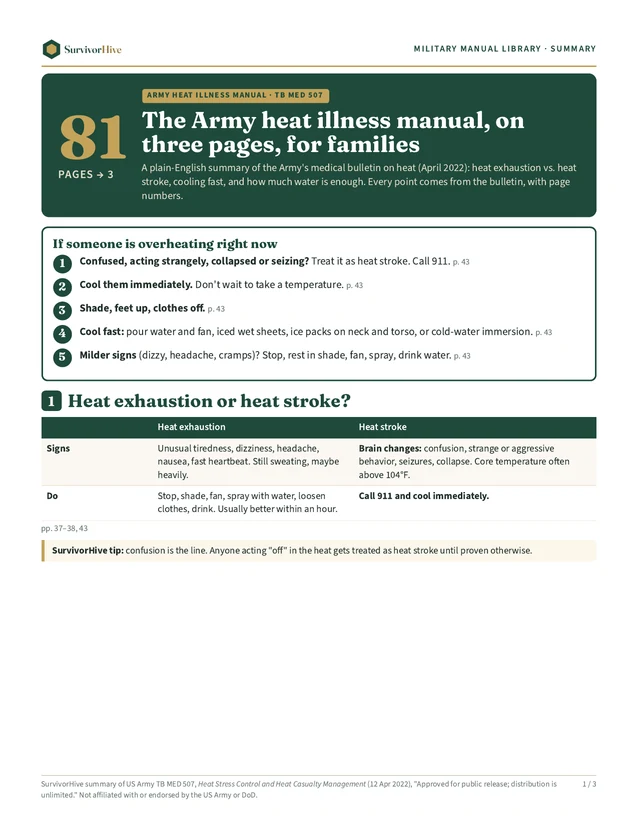
SurvivorHive Summary
3 printable pages: heat stroke vs. heat exhaustion, the cool-first steps, and water limits, with page numbers.
Get it free by email →If someone is overheating right now
- Confused, acting strangely, collapsed or having a seizure in the heat? Treat it as heat stroke. Call 911. p. 43
- Start cooling immediately. Delay in cooling is the biggest factor in death and disability. Don't wait to take a temperature. p. 43
- Lay them in the shade and strip off extra clothing. Raise their feet. p. 43
- Cool them fast. Pour water over them while fanning, wrap them in iced wet sheets, put ice packs on the neck, torso and head, or put them in cold water. p. 43
- Sips of water if they're awake. Milder signs (dizziness, headache, cramps)? Stop, rest in shade, fan, spray and drink. p. 43
What this manual is, and what it isn't
TB MED 507 is a technical bulletin from the Army's medical community on controlling heat stress and managing heat casualties. It explains how the body handles heat, how to plan work, rest and water in hot weather, and how heat illness is recognized and treated. It isn't a first-aid course, and a lot of it is written for doctors.
| The Army calls it | What it means for you |
|---|---|
| Heat acclimatization | Getting used to the heat over 1–2 weeks. p. 12 |
| Exertional heat stroke | Heat stroke from hard work or exercise. p. 38 |
| Classic heat stroke | Heat stroke from a heat wave, mostly in young kids and older adults. p. 38 |
| Hyponatremia | Low blood salt, usually from drinking too much water. p. 32 |
| WBGT | A heat index that combines temperature, humidity, sun and wind. p. 34 |
Ch. 2Getting used to the heatWhy the first hot days are the riskiest, and how to adapt.
The body adapts to heat with repeated exposure, a process called heat acclimatization. After it, body temperature and heart rate during work in the heat drop by about 2°F and 40 beats a minute, and sweating starts sooner. p. 11 One example in the bulletin: about 90% of soldiers can't patrol for 100 minutes in 120°F heat before adapting, but about 90% can do it easily after 10 days. p. 12
The Army's approach
- Aim for 4 to 14 days of heat exposure, at least 100 minutes a day
- Start slowly, and use work-rest cycles at first
- Build up heat and effort as tolerance allows
- Watch salt needs closely in the first week
For a soldier
Soldiers acclimatize before deploying to hot places and train in the coolest part of the day. p. 12For your family
For families, the first hot week of summer, a trip somewhere hotter, or a heat wave are when to go easy, rest more and drink on schedule.Ch. 3Water: enough, but not too muchHow much to drink, and the limits the Army sets.
Sweat losses of about 1 quart an hour are common during long, hard work in very hot weather. For a 176-pound person, losing 1½ quarts (about 2% of body weight) starts to hurt performance. p. 25
Checking if you're drinking enough
- Fewer than 3 trips to pee a day usually means you're not drinking enough. p. 30
- More than 7 a day with very light or clear urine can mean you're drinking too much. p. 30
- Food matters: salt is needed to hold on to water, so eat meals too. p. 30
Short on water? Cut sweat losses: work at night, do less in the heat of the day, find shade, and ration water for drinking. p. 30
Ch. 4Who's at higher riskThe personal and environmental risk factors.
| Personal risk factors | Environment |
|---|---|
| Not yet used to the heat; low fitness; a previous heat illness | High heat and humidity, in full sun |
| Fever or infection; some medications and supplements | Heavy clothing or gear |
| Sunburn or heat rash; dehydration | No breeze, no shade |
| Alcohol; lack of sleep | Heat stress the day before; no air conditioning |
Ch. 4The minor heat problemsCramps, fainting, swelling, heat rash and sunburn.
- Heat cramps are brief, painful muscle cramps. Salt in the diet can help prevent them. p. 36 p. 37
- Fainting in the heat often happens after standing a long time, or standing still after hard activity. People recover quickly once they sit or lie down, but fainting during or after work can be a sign of heat illness. p. 37
- Heat swelling of the hands and feet usually goes away within a few days as you adapt. p. 37
- Heat rash (prickly heat) is treated by cooling and drying the skin and avoiding heavy sweating. Clean, loose clothes help prevent it. p. 37
- Sunburn makes it harder to sweat and cool off. Use sunscreen and shade; cool compresses or aloe help. p. 36 p. 37
Ch. 4Heat exhaustionThe most common heat illness, and what to do.
Heat exhaustion is the most common heat illness. The body can't pump enough blood to both cool the skin and power the muscles. p. 37
Signs: unusual tiredness, stumbling or clumsiness, dizziness, headache, nausea or vomiting, a fast heart rate and fast breathing. Sweating continues and may be heavy. p. 38
What to do: stop the activity, get out of the heat and cool them quickly so it doesn't become something worse. p. 38 Rest them in the shade, fan them, spray them with water, loosen extra clothing and have them drink water. p. 43 People with heat exhaustion usually improve within the first hour. If they don't, or get worse, get medical help. p. 43
Ch. 4Heat stroke: a life-threatening emergencyConfusion plus heat. Cool first.
Heat stroke is a life-threatening condition marked by serious changes in how the brain is working, such as confusion, agitation, strange or aggressive behavior, seizures or collapse, along with a very high body temperature. It's often defined as a core temperature above 104°F, but the bulletin warns not to rely on one number.